TRT for women means testosterone therapy at low, physiologic doses that keep levels within the normal premenopausal female range. Testosterone is a normal and important hormone for women (Davis, 2025), and after menopause, testosterone therapy is backed by the highest grade of clinical trial evidence (Level I, Grade A) for low sexual desire that causes distress (Davis et al., 2019). Trials show better desire, arousal, orgasm, and pleasure. Vita Bella's hormone therapy care connects you with licensed providers across 47 states, with labs ordered first, so a provider can explain which options fit your goals.
What does TRT do for women? Testosterone's role in the body
As a therapy, TRT for women is used for low sexual desire that causes distress, and in postmenopausal women trials show better desire, arousal, orgasm, and pleasure (Islam et al., 2019). That benefit builds on testosterone's natural role in a woman's body.
Testosterone is a metabolic, vascular, and reproductive hormone in women (Parish et al., 2021). A 2025 review in Climacteric describes it as a normal female hormone with important effects in many tissues (Davis, 2025).
Women make testosterone and its precursors in the ovaries and the adrenal glands, and about half of circulating testosterone is formed in other tissues from those precursors (Parish et al., 2021). The ovary appears to keep producing it after menopause (Davison et al., 2005). Levels decline during the reproductive years and appear to be maintained after age 65 (Davis et al., 2019), and natural menopause itself does not appear to be a turning point for androgen levels (Davison et al., 2005).
Testosterone works in more than one way. It can act directly on androgen receptors, or the body can convert it to the more potent androgen dihydrotestosterone or to estradiol (Davis et al., 2019).
What are the benefits of testosterone for women?
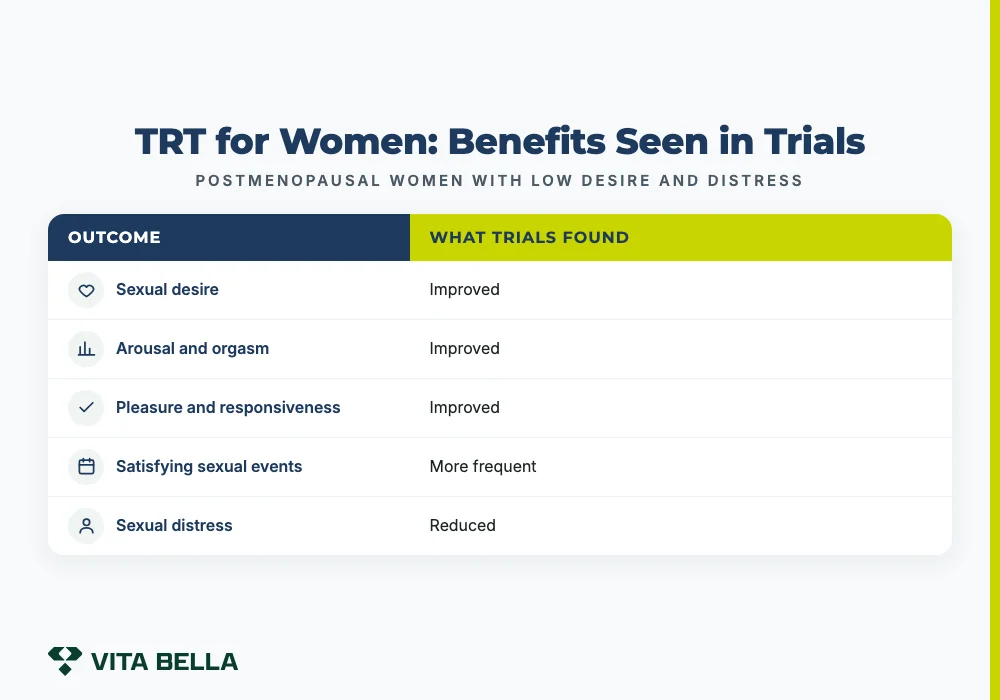
The benefits shown in clinical trials are in sexual function for women with low desire that causes distress (HSDD), and for postmenopausal women the evidence is strong and consistent across trials, reviews, and guidelines.
- Meta-analysis, 2019: 36 randomized trials with 8,480 participants. In postmenopausal women, testosterone significantly improved sexual desire, arousal, orgasm, pleasure, responsiveness, self-image, and the frequency of satisfying sexual events, and it reduced sexual concerns and distress. The authors concluded that testosterone is effective for postmenopausal women with low sexual desire causing distress (Islam et al., 2019).
- Systematic review, 2026: across 33 studies, testosterone therapy was effective for improving key aspects of sexual function. The strongest evidence was in postmenopausal women, where randomized trials show robust benefit, and early evidence in premenopausal women was promising (Furlan et al., 2026).
- Global Consensus, 2019: endorsed by The Endocrine Society, The North American Menopause Society, and other professional societies, it supports testosterone therapy for postmenopausal women with hypoactive sexual desire disorder (HSDD), meaning low sexual desire that causes distress, with data supporting a moderate therapeutic effect (Davis et al., 2019).
- ISSWSH guideline, 2021: it recommends transdermal testosterone for postmenopausal and late-reproductive-age women with HSDD after a full biopsychosocial assessment (Parish et al., 2021).
- Clinical review, 2025: a review in Obstetrics & Gynecology summarizes these guidelines for clinicians treating perimenopausal and postmenopausal women with HSDD (Kling, 2025).
The ISSWSH guideline concludes that despite substantial evidence on safety, efficacy, and clinical use, access to testosterone therapy for HSDD in women remains a significant unmet need (Parish et al., 2021).
Can women take TRT? Who it's for
Yes. If you are asking whether women can take TRT, testosterone replacement therapy for women has its strongest evidence for postmenopausal women with HSDD, diagnosed after a full biopsychosocial assessment (Davis et al., 2019; Parish et al., 2021). A licensed provider makes that assessment with you, looking at your symptoms, history, and labs together.
What a provider typically reviews when evaluating testosterone therapy for women:
- Your goals and history: especially whether low sexual desire with distress is the main concern
- Baseline labs: total testosterone, used as a baseline for monitoring, and SHBG, both recommended before starting, plus other tests when your history calls for them (Parish et al., 2021)
- Liver function and a fasting lipid profile: part of the baseline, and these tests are unaffected by physiologic doses of transdermal testosterone (Parish et al., 2021)
- Other influences on desire: medications, life events, and relationship factors, so other contributing factors can be identified (Parish et al., 2021)
- Pregnancy plans: confirmed before starting, since testosterone is not used in pregnancy (Parish et al., 2021)
Total testosterone is used as a baseline for monitoring rather than to diagnose HSDD (Parish et al., 2021). Your provider brings the whole picture together.
Before and after menopause: who fits where?
Postmenopausal women are the most-studied group, with randomized trials showing robust benefit (Furlan et al., 2026). For women in their late reproductive years, the ISSWSH guideline notes that limited data also support testosterone therapy for HSDD (Parish et al., 2021), and a 2026 review called the early evidence before menopause promising (Furlan et al., 2026). A provider considers your life stage together with your symptoms and history.
How is TRT for women given?
Guidelines recommend transdermal testosterone for women, applied to the skin as a cream or gel at doses that keep levels within the normal premenopausal female range (Parish et al., 2021). That is how TRT for women is typically given. Transdermal forms are preferred for their neutral effect on blood lipids (Islam et al., 2019).
Women's doses are calibrated to the female range, far below male protocols, and a licensed provider determines the dose after reviewing your labs. Small daily amounts can be adjusted in steps based on follow-up labs and your response.
For a closer look at daily use, see the guide to testosterone cream for women, and the guide to testosterone pellets for women explains how pellets compare.
What to expect: a realistic timeline for TRT results in women
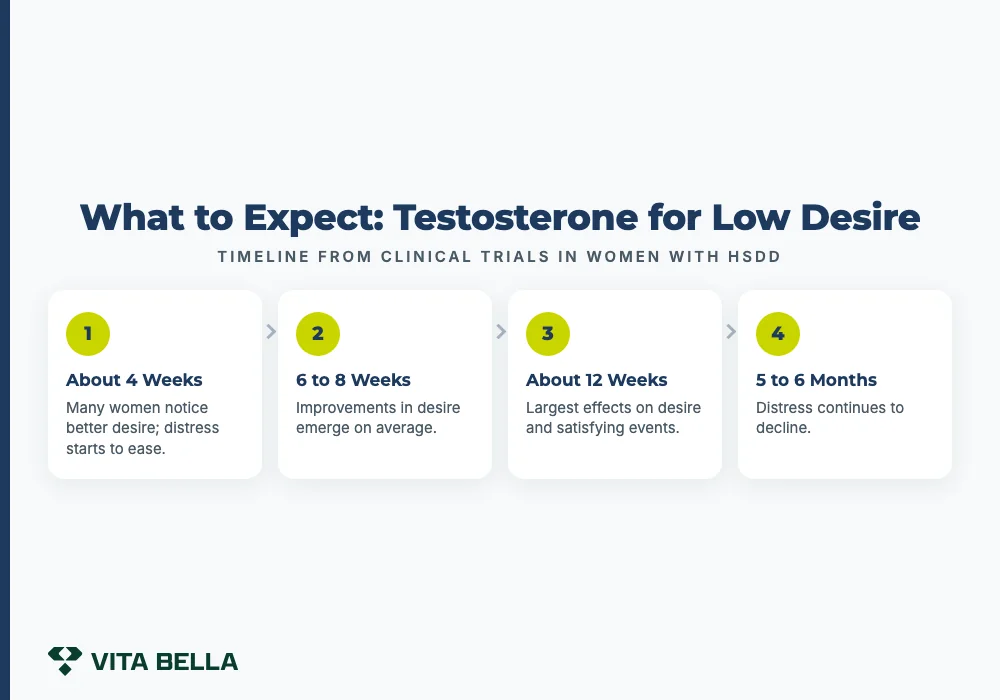
The ISSWSH guideline gives a clear, encouraging timeline based on clinical trial data (Parish et al., 2021):
- Around 4 weeks: many women notice improvement in desire, and sexually related distress starts to ease.
- 6 to 8 weeks: on average, improvements in desire emerge.
- About 12 weeks: the largest effects on sexual desire and satisfying sexual events.
- Over the 5 to 6 months after the first changes: distress continues to decline.
Individual response varies. Your provider tracks progress at follow-up visits, looking at changes in desire and distress alongside your labs, and adjusts the approach when needed.
How providers keep TRT for women on track
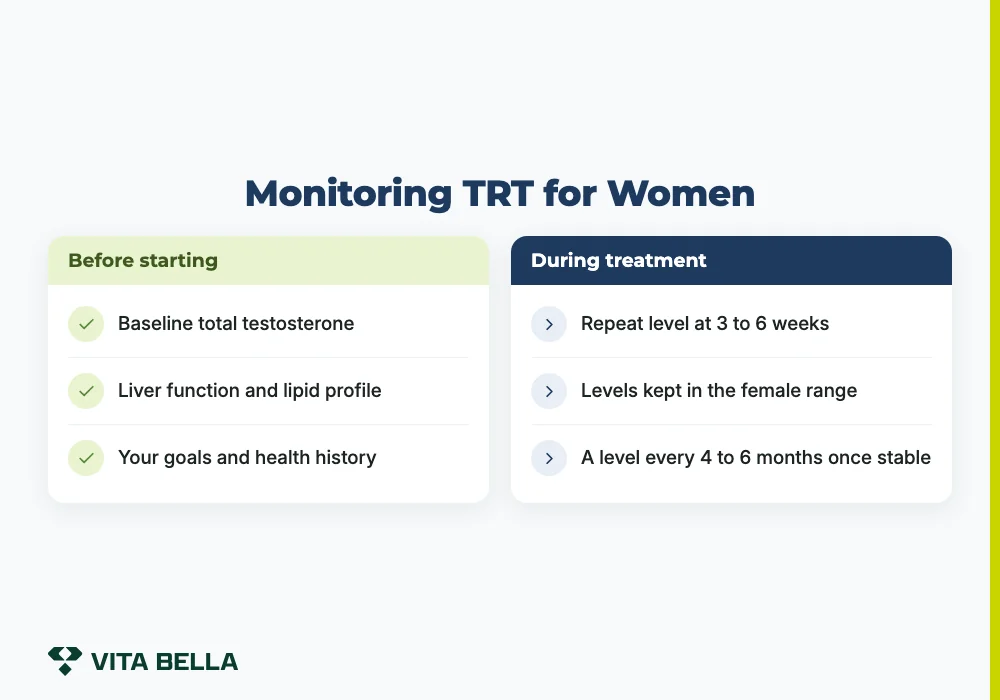
Monitoring keeps testosterone therapy for women within the normal premenopausal female range. Guidelines describe a simple routine (Davis et al., 2019; Parish et al., 2021):
- Before starting: a baseline total testosterone level.
- 3 to 6 weeks after starting: a repeat level checks that testosterone sits within the normal premenopausal range, so the dose can be adjusted if needed.
- Once levels are stable: a total testosterone level every 4 to 6 months (Parish et al., 2021).
The safety data are reassuring. In the trials included in the 2019 meta-analysis, no serious adverse events were recorded (Islam et al., 2019). In clinical trials of postmenopausal women using doses that keep testosterone in the female range, therapy was not associated with increases in blood pressure, blood glucose, or HbA1c (Davis et al., 2019).
What are the side effects of testosterone therapy in women?
Possible side effects, uncommon at physiological doses, are usually mild and reversible under provider monitoring. Keeping levels within the normal female range is how providers keep TRT for women comfortable.
Labs and monitoring: what to expect before and during TRT
At Vita Bella, labs are ordered first through Quest Diagnostics and billed separately from the membership fee. The results give your provider a clear starting point for explaining which options fit your goals.
For women, guidelines use total testosterone as the main measure and set a safe range rather than one number: levels are kept within the normal premenopausal female range, and your provider reads them alongside symptoms and response (Davis et al., 2019; Parish et al., 2021). The article on how SHBG shapes a testosterone result explains how SHBG and total testosterone relate. After therapy begins, follow-up labs help your provider keep levels within that range and guide any adjustments.
Talking with a provider about TRT as a woman
Telehealth makes it easier to talk with a licensed provider about testosterone replacement for women and other hormone questions, without a specialist referral. At Vita Bella, labs are ordered first through Quest Diagnostics, then a licensed provider reviews the results with you and explains which options fit your goals. You select your own provider from a licensed network across 47 states.
For membership details, visit the Vita Bella Performance Membership page.
Ready to find out if testosterone therapy is right for you?
The answer comes from a conversation with a licensed provider, who reviews your symptoms, goals, and labs with you and explains what fits.
Transform Your Life. You Owe It To Yourself.
Frequently asked questions
TRT for women is testosterone therapy at low, physiologic doses that keep levels within the normal premenopausal female range. Its strongest evidence is for postmenopausal women with low sexual desire that causes distress, where trials show better desire, arousal, orgasm, and pleasure (Islam et al., 2019; Davis et al., 2019).
Yes, in some cases. The strongest evidence is after menopause, while for women in their late reproductive years with low desire that causes distress, the ISSWSH guideline notes that limited data also support testosterone therapy (Parish et al., 2021). A provider considers your life stage together with your symptoms and history.
For low desire with distress, many women feel improvement after about 4 weeks, improvements emerge on average at 6 to 8 weeks, and the largest effects on desire come at about 12 weeks (Parish et al., 2021). Your provider tracks your response at follow-up visits.
Possible side effects, uncommon at physiological doses, are usually mild and reversible under provider monitoring. In the trials included in the 2019 meta-analysis, no serious adverse events were recorded (Islam et al., 2019).
Two things differ: the purpose and the dose. For women, testosterone therapy is used for low sexual desire that causes distress, identified through a clinical assessment rather than a blood level, and because women's testosterone levels are much lower than men's, TRT for women is calibrated to keep testosterone within the normal premenopausal female range, checked with follow-up labs (Davis et al., 2019; Parish et al., 2021).
Sources
- Davis SR et al. (2019). Global Consensus Position Statement on the Use of Testosterone Therapy for Women. Journal of Clinical Endocrinology and Metabolism. PubMed
- Islam RM, Bell RJ, Green S, Page MJ, Davis SR. (2019). Safety and efficacy of testosterone for women: a systematic review and meta-analysis of randomised controlled trial data. Lancet Diabetes & Endocrinology. PubMed
- Furlan VA, Hammad MAM, Quesada S, Nguyen S, Yih J. (2026). Testosterone therapy for female sexual dysfunction: a systematic review of the literature demonstrating outcomes in premenopausal and postmenopausal women. Journal of Sexual Medicine. PubMed
- Parish SJ, Simon JA, Davis SR, et al. (2021). International Society for the Study of Women's Sexual Health Clinical Practice Guideline for the Use of Systemic Testosterone for Hypoactive Sexual Desire Disorder in Women. Journal of Sexual Medicine. PubMed
- Kling JM. (2025). Testosterone for the Treatment of Hypoactive Sexual Desire Disorder in Perimenopausal and Postmenopausal Women. Obstetrics and Gynecology. PubMed
- Davis SR. (2025). Not just sex: other roles for testosterone in women. Climacteric. PubMed
- Davison SL, Bell R, Donath S, et al. (2005). Androgen levels in adult females: changes with age, menopause, and oophorectomy. Journal of Clinical Endocrinology and Metabolism. PubMed