


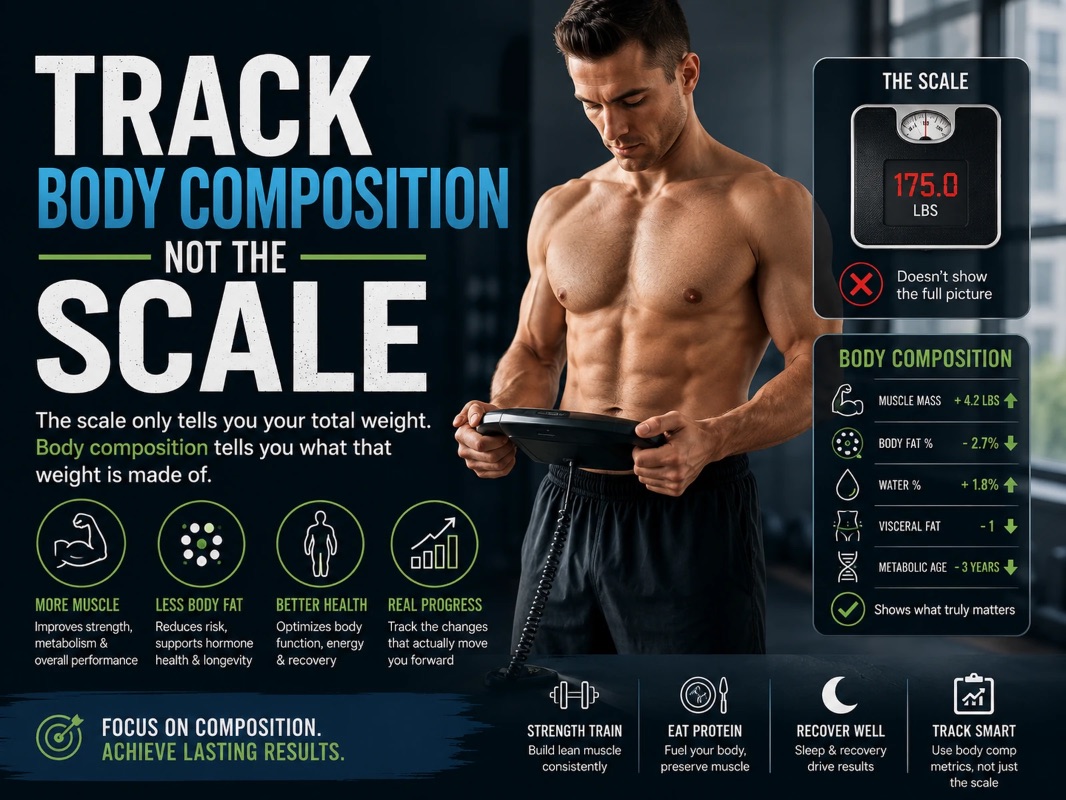
Beyond Body Weight
A bathroom scale tells you total mass. It does not tell you how much of that mass is muscle, how much is fat under the skin, or how much is the deeper fat that surrounds organs. Two people can weigh the same yet have very different body composition and different health risks. Tracking the breakdown of muscle versus fat gives a clearer picture of progress and risk than weight alone.
Muscle Versus Fat
Skeletal muscle is metabolically active tissue that supports strength, glucose disposal, and physical capacity. Fat mass serves as energy storage but, when excessive, contributes to inflammation and metabolic strain. Losing weight while also losing muscle can leave a person lighter yet weaker and less metabolically resilient. Gaining muscle while reducing fat improves function even if the scale moves little. Body-composition data separates these two compartments so training and nutrition decisions can be adjusted accurately.
Visceral Fat: What It Is and Why It Matters
Visceral fat is the fat stored deep in the abdomen around the liver, intestines, and other organs. Unlike subcutaneous fat (the layer under the skin), visceral fat is metabolically active. It releases inflammatory cytokines and free fatty acids directly into the portal circulation that feeds the liver.
Human studies consistently link higher visceral fat to increased risk of metabolic syndrome, type 2 diabetes, coronary artery disease, heart failure, atrial fibrillation, and stroke—often independent of overall body-mass index. Even people with a “normal” BMI can carry elevated visceral fat and elevated cardiometabolic risk. Measuring or estimating this depot therefore adds information the scale cannot provide.
Inexpensive and Accessible Options: InBody and Similar Scanners
Many gyms and some chiropractic or physical-therapy offices offer bioelectrical impedance analysis (BIA) devices such as InBody scanners. These machines send a low-level electrical current through the body and estimate fat mass, lean mass, and, on many models, visceral-fat level from the resistance and reactance of the tissues. Scans typically take under a minute and cost little—often free with a membership or available for a modest fee.
BIA is not as precise as imaging methods, and results can shift with hydration, recent food intake, exercise, and time of day. Still, when used consistently under the same conditions, these devices provide useful trend data for most people at far lower cost and greater convenience than clinical imaging.
Consistency Is Essential
Because BIA readings are sensitive to body water, the same protocol should be followed every time: same time of day (ideally morning), similar hydration status, empty bladder, no recent large meal or intense exercise, and similar clothing. Measuring under varying conditions can create artificial swings of several percentage points that have nothing to do with true changes in fat or muscle. Consistent conditions turn an imperfect tool into a reliable tracker of direction over weeks and months.
Higher-Precision Option: DEXA
Dual-energy X-ray absorptiometry (DEXA or DXA) is widely regarded as a clinical reference method for body composition. It uses two low-dose X-ray beams to distinguish fat mass, lean soft tissue, and bone mineral. DEXA also provides regional data (arms, legs, trunk) and can quantify visceral adipose tissue more directly than most BIA devices. Accuracy for total body fat is typically within 1–2 percent under standardized conditions.
DEXA costs more (often $100–300 per scan) and requires a medical or specialized facility. Radiation exposure is very low. It is useful for establishing a precise baseline, verifying large changes, or evaluating bone density at the same time. Many people use DEXA periodically and rely on more frequent, lower-cost BIA scans for day-to-day tracking.
Putting the Data to Work
Regular body-composition data helps separate successful muscle gain from simple weight gain, or successful fat loss from unwanted muscle loss. It also flags rising visceral fat even when overall weight is stable. These insights guide adjustments in training, protein intake, sleep, and overall recovery.
Hormone status influences both muscle protein synthesis and fat distribution. When laboratory trends or symptoms suggest evaluation is useful, supervised hormone and peptide support can be coordinated through resources such as Vita Bella.
For individuals already tracking composition and refining training or nutrition, the same clinical teams at Vita Bella can help integrate hormone-related findings with body-composition goals when appropriate.
References
Shah RV, Murthy VL, Abbasi SA, et al. Visceral adiposity and the risk of metabolic syndrome across body mass index: the MESA study. JACC Cardiovasc Imaging. 2014;7(12):1221-1235. doi:10.1016/j.jcmg.2014.07.017
Neeland IJ, Ross R, Després JP, et al. Visceral and ectopic fat, atherosclerosis, and cardiometabolic disease: a position statement. Lancet Diabetes Endocrinol. 2019;7(9):715-725. doi:10.1016/S2213-8587(19)30084-1
Ling CHY, de Craen AJM, Slagboom PE, et al. Accuracy of direct segmental multi-frequency bioimpedance analysis in the assessment of total body and segmental body composition in middle-aged adult population. Clin Nutr. 2011;30(5):610-615. doi:10.1016/j.clnu.2011.04.001
Kyle UG, Bosaeus I, De Lorenzo AD, et al. Bioelectrical impedance analysis—part I: review of principles and methods. Clin Nutr. 2004;23(5):1226-1243. doi:10.1016/j.clnu.2004.06.004
Hangartner TN, Warner S, Braillon P, Jankowski L, Shepherd J. The Official Positions of the International Society for Clinical Densitometry: acquisition of dual-energy X-ray absorptiometry body composition and considerations regarding analysis and repeatability of measures. J Clin Densitom. 2013;16(4):520-536. doi:10.1016/j.jocd.2013.08.007