PDA peptide dosage is not a fixed number. It depends on your route of administration, formulation stability, and the labs a licensed provider reviews before prescribing. Pentadeca arginate is a 15-amino-acid peptide stabilized with an arginate salt, which improves structural consistency across a treatment cycle compared to BPC-157. Because no standardized human clinical data exist for PDA, every pentadeca arginate protocol begins with provider assessment, not a milligram figure from a forum.
Route and formulation shape your PDA peptide dosage
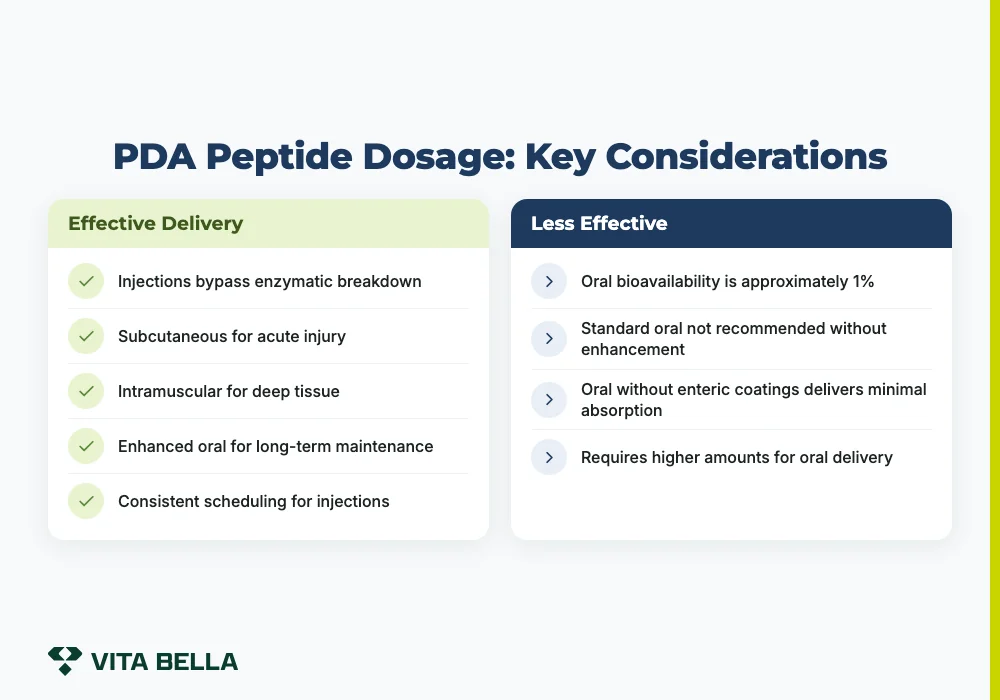
The single biggest variable in any peptide dosing guide is how the compound enters your body. Injections bypass enzymatic breakdown entirely. A 2020 review in Advanced Drug Delivery Reviews (Brayden et al.) found that oral bioavailability for peptides is approximately 1% compared to injection, meaning oral delivery requires substantially higher amounts or advanced formulations to reach comparable systemic exposure. That gap matters when a provider structures your pda peptide protocol.
The table below compares delivery routes for pentadeca arginate.
| Route | Relative bioavailability | Primary use case | Key formulation requirement |
|---|---|---|---|
| Subcutaneous injection | High | Acute injury, post-surgery | Sterile technique, site rotation |
| Intramuscular injection | High | Deep tissue targeting | Consistent scheduling |
| Oral (standard) | Very low vs injection (Brayden et al., 2020) | Not recommended without enhancement | Enteric coating and absorption aids |
| Oral (enteric-coated/enhanced) | Improved vs standard oral | Long-term maintenance | Permeation enhancers or lipid carriers |
Formulation quality determines whether an oral product produces measurable effect. A 2021 study in the International Journal of Peptide Research and Therapeutics (Patil et al.) confirmed that oral capsules without enteric coatings or lipid carriers deliver minimal absorption. Consistent scheduling matters. For pentadeca arginate injection protocols, site rotation and regular dosing maintain the cumulative tissue exposure that supports recovery.
How much PDA peptide should I take per day?
A licensed provider determines the dose after labs. There is no published, standardized human daily dose for pentadeca arginate. Preclinical data on BPC-157-family peptides, summarized in a 2025 systematic review in HSS Journal (Vasireddi et al.), show clear effects in poorly vascularized tissues like tendons and myotendinous junctions, but those findings do not translate directly into a human pda peptide dosage recommendation without individual assessment.
Your provider evaluates injury severity, body composition, administration route, and baseline lab results before arriving at a starting point. More significant injuries, longer treatment phases, and different routes all shift where the dose lands. The pda peptide protocol suited for post-surgical recovery looks different from one designed for ongoing joint maintenance.
What is the difference between PDA and BPC-157 dosage?
PDA and BPC-157 share the same 15-amino-acid sequence. The difference is structural: BPC-157 uses a free acid form, while pentadeca arginate uses an arginate salt that improves stability. That modification changes how the compound behaves in solution, affecting both shelf life and tissue uptake.
From an evidence standpoint, the BPC-157 vs pentadeca arginate comparison matters because dosage benchmarks come from the compound with more data. BPC-157 has been evaluated in three human pilot trials covering intra-articular knee pain, interstitial cystitis, and intravenous pharmacokinetics (Vasireddi et al., 2025). PDA has no equivalent human pharmacokinetic data yet. A provider calibrating pentadeca arginate dosage works from the BPC-157 safety record while accounting for the formulation difference. It is not a simple one-to-one conversion.
How often should you inject pentadeca arginate?
Frequency is provider-set, not self-assigned. The main reason: a 2025 HSS Journal systematic review (Vasireddi et al.) found that BPC-157 has a half-life of under 30 minutes following single and repeated intramuscular and intravenous doses. Short half-life means tissue exposure drops quickly after each injection. Irregular dosing undercuts the angiogenic and fibroblast-activity effects that make pentadeca arginate relevant for connective tissue repair.
Consistent scheduling, combined with site rotation to prevent local reactions, keeps cumulative exposure steady. Your provider sets the interval based on your early response and what follow-up labs show.
Pentadeca arginate for injuries: choosing your route
Choosing the right pda peptide dosage for an acute injury versus a maintenance goal starts with understanding which tissue you are targeting and how blood supply limits delivery. Acute repair is where pentadeca arginate injection has the clearest theoretical support. The 2025 Vasireddi et al. review found that BPC-157-family compounds encourage angiogenesis, fibroblast activity, and neuromuscular stability in tendons and poorly vascularized connective tissue. Research on peptide modifications that promote endothelial repair also suggests arginate-type structural changes can influence vascular tissue remodeling (Lee et al., 2014).
For long-term goals like joint support or gut barrier maintenance, an oral form with advanced delivery technology may be practical. The full-spectrum approach to injury recovery that most providers recommend treats route selection as one layer of a broader protocol. Physical therapy, nutrition, and load management all determine how well any peptide therapy performs.
Can you take pentadeca arginate orally instead of injecting?
Yes, but the pharmacokinetics are very different. Oral peptides face three compounding challenges: enzymatic breakdown in the gut, poor membrane permeability, and first-pass liver metabolism. A 2024 review in the International Journal of Molecular Sciences (Nicze et al.) confirmed that without enteric coatings or lipid-based carrier systems, oral peptide delivery produces minimal systemic effect.
Think of oral pentadeca arginate as a maintenance-phase tool, not an acute repair strategy. It suits long-term support goals where convenience and consistency matter more than peak tissue concentration. For injuries requiring a fast, targeted response, injection remains the provider-preferred route in the current evidence picture.
Is pentadeca arginate safe to self-administer?
Not without guidance. Subcutaneous and intramuscular injections require sterile technique, and errors create real infection risk. No officially established human safety profile exists for pentadeca arginate specifically.
Related peptides like BPC-157 showed favorable tolerance in three supervised pilot trials (Vasireddi et al., 2025). Favorable in a controlled research setting is not the same as safe to dose independently at home. Any pentadeca arginate for injuries protocol should run alongside physical rehabilitation and regular provider check-ins, with monitoring for local injection reactions and unexpected systemic responses. A peptide dosing guide cannot replace that clinical relationship, and neither can a fixed pda peptide dosage recommendation found online.
To understand how providers structure and sequence peptide programs across multiple cycles, including how schedules are adjusted based on response, that resource covers multi-peptide program structure in detail.
Ready to build your PDA peptide dosage plan?
Getting the right pentadeca arginate dosage requires more than reading a protocol online. A licensed provider reviews your labs, injury history, and recovery goals before recommending a route, formulation, and schedule. Vita Bella connects you with providers across 47 states who build your program around your individual picture, not a generic milligram target.
Frequently asked questions
A licensed provider determines the right pda peptide dosage after reviewing your labs and injury status. No standardized human daily dose has been published for pentadeca arginate. The appropriate amount depends on your route, formulation quality, and the specific tissue you are targeting.
PDA and BPC-157 share the same amino acid sequence but differ in their salt modification, which affects stability and tissue uptake. BPC-157 has limited human pilot data; PDA does not. Providers account for this evidence gap when calibrating any pentadeca arginate dosage.
Injection frequency is set by a provider after labs and depends on the phase of treatment and your early response. The short half-life of BPC-157-family peptides means consistent scheduling matters more than any single large dose.
Yes, but oral bioavailability is substantially lower than injection due to enzymatic breakdown and poor gut permeability. An oral pentadeca arginate dose needs to be significantly higher, and the formulation requires absorption-enhancing technology to produce measurable systemic effects.
Without provider oversight, self-injection carries real risks related to sterile technique, site selection, and unmonitored reactions. Any pentadeca arginate protocol should be supervised by a licensed provider and combined with rehabilitation and regular lab monitoring.
Sources
- Vasireddi, N., Hahamyan, H. A., Salata, M. J., Karns, M., Calcei, J. G., Voos, J. E., & Apostolakos, J. M. (2025). Emerging use of BPC-157 in orthopaedic sports medicine: A systematic review. HSS Journal. PubMed
- Brayden, D. J., Hill, T. A., Fairlie, D. P., Maher, S., & Mrsny, R. J. (2020). Systemic delivery of peptides by the oral route: Formulation and medicinal chemistry approaches. Advanced Drug Delivery Reviews, 157, 2–36. Source
- Brayden, D. J. (2023). An update on oral administration of peptides to achieve systemic delivery. American Pharmaceutical Review. Source
- Nicze, M., Borówka, M., Dec, A., Niemiec, A., Bułdak, Ł., & Okopień, B. (2024). The current and promising oral delivery methods for protein- and peptide-based drugs. International Journal of Molecular Sciences, 25(2), 815. PubMed
- Patil, S., Gupta, K., Pandit, A., Desai, B., Gschliesser, S., Dandekar, P., & Jain, R. (2021). Oral delivery of peptide formulations and their cellular evaluation. International Journal of Peptide Research and Therapeutics, 27(4), 2831–2844. Source
- Lee, J. S. et al. (2014). Mussel-inspired cell-adhesion peptide modification for enhanced endothelialization of decellularized blood vessels. Macromolecular bioscience. PubMed