Not all peptides carry the same risk. Research peptides safety depends entirely on source, regulatory status, and medical oversight. Compounds sold as "for research use only" bypass FDA inspection. That removes any assurance of purity, accurate concentration, or accountability when something goes wrong. Doctor supervised peptide therapy at an FDA-inspected, state-licensed pharmacy is a fundamentally different category from anything sold as a research chemical.
Research peptides safety: what separates regulated from unregulated compounds
The peptide category is large, but not all compounds inside it receive the same scrutiny. Between 2016 and 2022, the FDA authorized 26 peptide medications out of 315 new drug approvals during that same period, according to a 2023 analysis in Molecules. Synthetic peptides represented more than 11% of FDA-authorized medications from 2016 to 2024, a 2025 paper in the Journal of Peptide Science found. Both figures reflect a rigorous review process, not just molecular structure.
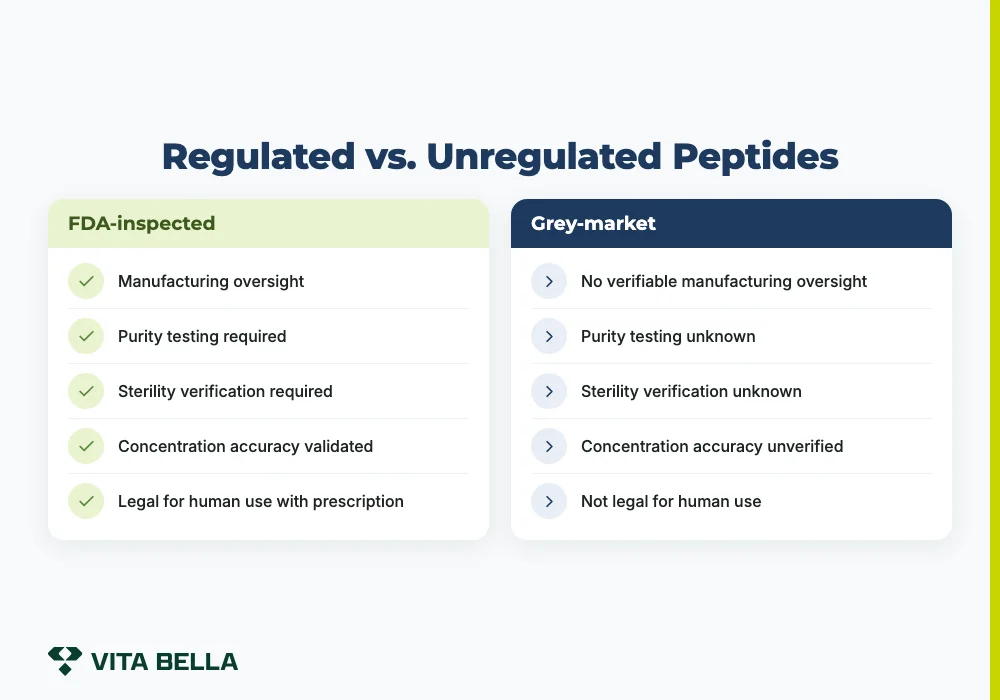
Grey market peptides share a chemical category with those authorized compounds. That is where the similarity ends.
| Feature | FDA-inspected peptides | Grey-market research peptides |
|---|---|---|
| Manufacturing oversight | Yes, FDA-inspected facility | None verifiable |
| Purity testing | Required | Unknown |
| Sterility verification | Required | Unknown |
| Concentration accuracy | Validated | Unverified |
| Legal for human use | With a valid prescription | No |
| Provider accountability | Required | None |
Are research peptides safe for human use?
No. Research peptides sold as "not for human consumption" have not been cleared for medical use. That designation is not a technicality. It means the compound has not been inspected for sterility, tested for purity, or validated for accurate concentration under any regulatory standard.
The label exists because sellers cannot legally market these compounds as medications. It does not make them safer. Research peptides safety cannot be inferred from chemical similarity to an authorized drug alone. What therapeutic peptides are and how they work shows clearly what separates an authorized treatment from a grey-market vial.
What are the dangers of taking unregulated peptides?
Unregulated peptide risks are serious and documented. A 2026 paper in Missouri Medicine by Moiz et al. found that consumers who self-administer injectable peptides and other unregulated compounds face risks that licensed providers are specifically trained to identify and prevent.
Peptide contamination dangers include:
- Bacterial endotoxins from non-sterile production environments
- Concentrations significantly above or below the labeled amount
- Unidentified impurities that trigger immune reactions
- Degraded compounds that offer no benefit while still introducing unknown substances into the body
Immunogenicity is a specific concern. The immune system can generate antidrug antibodies against a poorly characterized peptide, according to a 2025 study in Frontiers in Immunology. That reaction can stem from the compound itself or from manufacturing contaminants. Authorized peptide medications require immunogenicity risk evaluation before approval. Grey-market products carry no equivalent requirement.
What are the risks of buying peptides online?
Buying peptides online from unvetted sources creates medical and legal risk on two fronts. For providers, recommending non-FDA-inspected compounds carries significant legal liability. Patients have no regulatory recourse when an unlabeled product causes harm. The exposure is real and documented.
A 2013 review found that peptide hormone abuse increases the risk of atherosclerosis, thrombosis, osteoporosis, and cancer. The same analysis identified additional documented effects: motor paralysis, skeletal muscle damage, diabetes mellitus, hypothyroidism, arterial hypertension, sweating, headaches, and vomiting. These are not theoretical outcomes.
The FDA has specifically warned consumers against purchasing unapproved semaglutide, tirzepatide, and retatrutide from vendors using labels like "for research use only." Such products are of uncertain quality and may cause harm.
Can unregulated peptides cause long-term organ damage?
Yes. The documented risks are not limited to immediate reactions. Atherosclerosis and thrombosis develop over years without obvious early symptoms. Hormonal disruptions from uncontrolled peptide use, including effects on thyroid function and blood glucose regulation, can accumulate before they become apparent.
Regulatory frameworks for authorized peptide medications require manufacturers to characterize and limit impurities across the full product lifecycle, according to a 2025 analysis in Separation Science Plus. No equivalent standard applies to grey-market research peptides. That absence is structural, not incidental.
Without a licensed provider, there is no monitoring. Clinical peptide cycling protocols exist precisely because provider oversight allows early identification of adverse signals and protocol adjustment before harm progresses. Research peptides safety simply cannot be ensured outside that structure.
Take the right first step
If you are considering peptides for recovery, hormone support, or longevity, start with a licensed provider, not an online storefront. At Vita Bella every protocol uses compounds from FDA-inspected, state-licensed U.S. pharmacies, with 1:1 provider care at every stage.
Frequently asked questions
No. Research peptides carry explicit labels stating they are not for human consumption and have not been authorized for medical use. Using them outside a controlled research setting is both unsafe and potentially unlawful for anyone involved.
Compounding pharmacy peptides are prepared by licensed pharmacies under state law pursuant to a valid prescription from a licensed provider. Grey-market research peptides have no verified purity, no sterility testing, and no regulatory accountability of any kind.
A licensed provider selects compounds from FDA-inspected sources, reviews your health history, and monitors your response throughout the protocol. That accountability directly addresses the core dangers of unregulated peptides: contamination, inaccurate concentrations, and undetected adverse effects.
Labels reading "for research use only" or "not for human consumption," paired with consumer-facing dosing guidance or wellness claims, indicate a product is not authorized for human use. The FDA has specifically warned about vendors selling semaglutide and tirzepatide this way.
Yes. Impurities in grey-market peptides can cause antidrug antibody formation, an immune reaction that authorized peptide medications are required to assess before approval. Unregulated products carry no such evaluation, so immune reactions can occur without any prior warning.
Sources
- Moiz A et al. (2026). Dangers of Injectable Peptides and Other Unregulated "Biohacking" Drugs. Missouri Medicine. PubMed
- Rossino G et al. (2023). Peptides as Therapeutic Agents: Challenges and Opportunities in the Green Transition Era. Molecules. PubMed
- Achilleos K et al. (2025). Beyond Efficacy: Ensuring Safety in Peptide Therapeutics through Immunogenicity Assessment. Journal of Peptide Science. PubMed
- Puig M, Shubow S. (2025). Immunogenicity of therapeutic peptide products: bridging the gaps regarding the role of product-related risk factors. Frontiers in Immunology. link
- Fosgerau K, Hoffmann T. (2015). Peptide therapeutics: current status and future directions. Drug Discovery Today. PubMed
- Giri T et al. (2025). Regulatory Considerations in Synthetic Peptide Characterization: Techniques and Compliance. Separation Science Plus. link
- Ferrari CK. (2013). Critical aspects of peptide hormone abuse in exercise and sports: an update. Rev Fac Cien Med Univ Nac Cordoba. PubMed
- FDA's Concerns with Unapproved GLP-1 Drugs Used for Weight Loss. U.S. Food and Drug Administration. FDA.gov