Combining peptides with TRT creates a hormone optimization approach that testosterone alone cannot replicate. TRT restores energy, muscle density, and libido. It also suppresses LH and FSH production, which dampens the body's own hormone signals over time. Growth hormone releasing peptides fill that gap, elevating GH and IGF-1 while supporting tissue repair and natural hormonal signaling. To see how that protocol works in practice, start with Vita Bella's TRT program.
What peptides work best with testosterone therapy?
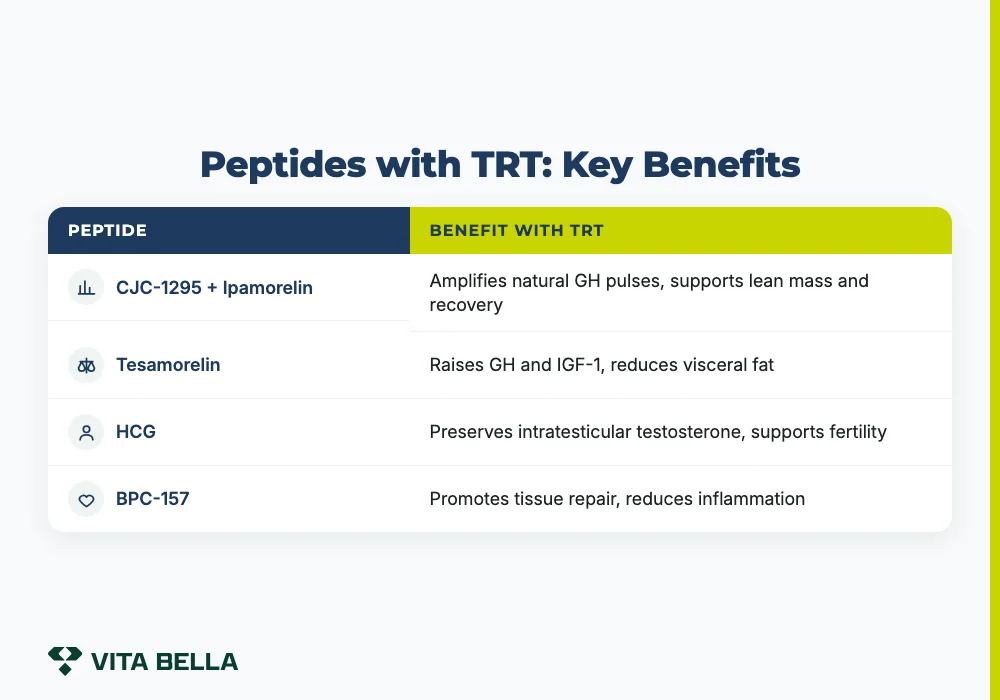
Four compound classes consistently complement TRT, each addressing a gap that testosterone alone leaves open.
| Peptide | Primary role with TRT |
|---|---|
| CJC-1295 + Ipamorelin | Amplifies natural GH pulses; supports lean mass and recovery |
| Tesamorelin | Raises GH and IGF-1; reduces visceral fat |
| HCG | Preserves intratesticular testosterone; supports fertility |
| BPC-157 | Promotes tissue repair; reduces inflammation |
CJC-1295 testosterone therapy works through pulsatile GH stimulation. CJC-1295 at Vita Bella carries no DAC modification, meaning it amplifies a single natural GH pulse rather than creating a sustained reservoir effect. Paired with ipamorelin, this ipamorelin TRT stack produces a controlled GH release that builds across regular doses, supporting lean muscle and faster recovery.
Tesamorelin and testosterone address overlapping but separate pathways. Tesamorelin is a growth hormone-releasing hormone analogue that drives GH secretion from the pituitary. In a randomized, placebo-controlled trial, Clemmons et al. (2017) found tesamorelin raised IGF-1 by more than 180 µg/L on average and reduced visceral fat by 15 to 20%.
A 2026 meta-analysis by Badran et al. in Obesity Research & Clinical Practice confirmed those body composition effects across multiple randomized controlled trials, adding further clinical support for tesamorelin's role in combined protocols.
BPC-157 with testosterone adds a tissue-repair layer. BPC-157 has documented anti-inflammatory and regenerative properties, making it especially useful for anyone training hard while on TRT. Recovery between sessions improves. Connective tissue stress decreases.
Can you take peptides and testosterone at the same time?
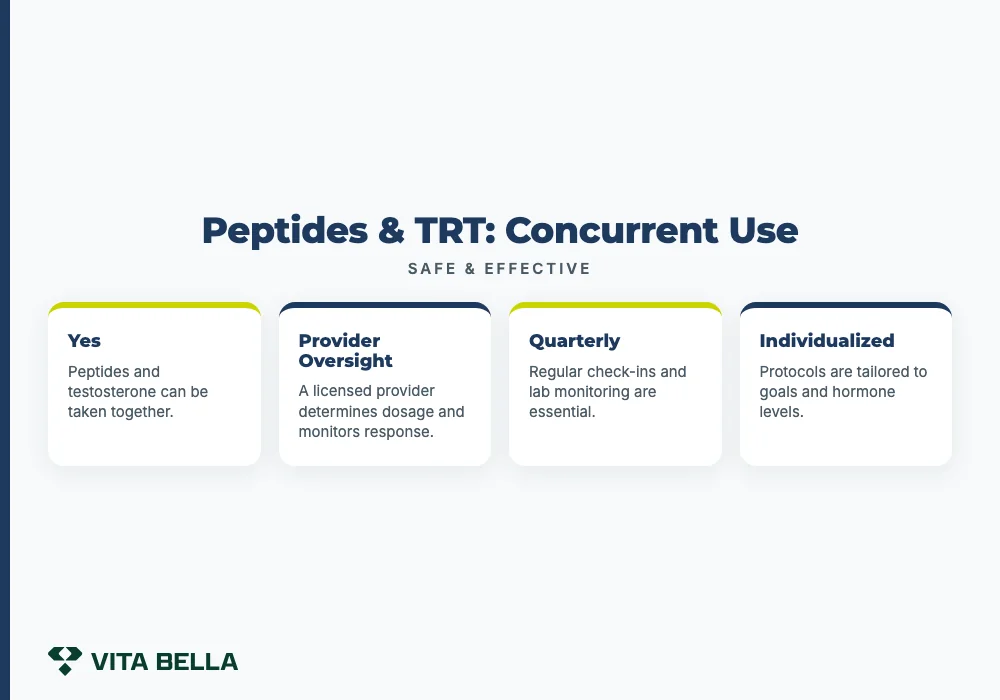
Yes. Peptides and testosterone work through distinct receptor systems, so concurrent use is both feasible and common in supervised hormone optimization therapy. The key requirement is provider oversight.
A licensed provider determines the dose after reviewing labs and monitors response at quarterly provider check-ins. The 2018 Endocrine Society clinical practice guideline (Bhasin et al.) establishes that individualized protocols and regular laboratory monitoring are foundational to safe testosterone therapy, and the same framework applies when peptides are added to the protocol.
For a broader look at how GH secretagogue stacks are structured and adjusted over time, the specifics vary by goals and baseline hormone levels.
How does tesamorelin complement TRT?
Tesamorelin fills a gap TRT cannot. Testosterone improves anabolic signaling directly but has limited impact on GH secretion or IGF-1 levels. Tesamorelin stimulates the pituitary to release growth hormone, raising IGF-1 through a physiologically grounded pathway. The downstream effects include reduced visceral fat, improved sleep quality, and better tissue regeneration, each of which complements what TRT provides at the muscle and libido level.
Two 2026 analyses, Ditta et al. and Badran et al., confirm tesamorelin's body composition benefits in controlled trials. Combined with testosterone, the result is hormone optimization therapy operating at multiple axes simultaneously.
What is the best peptide stack for TRT users?
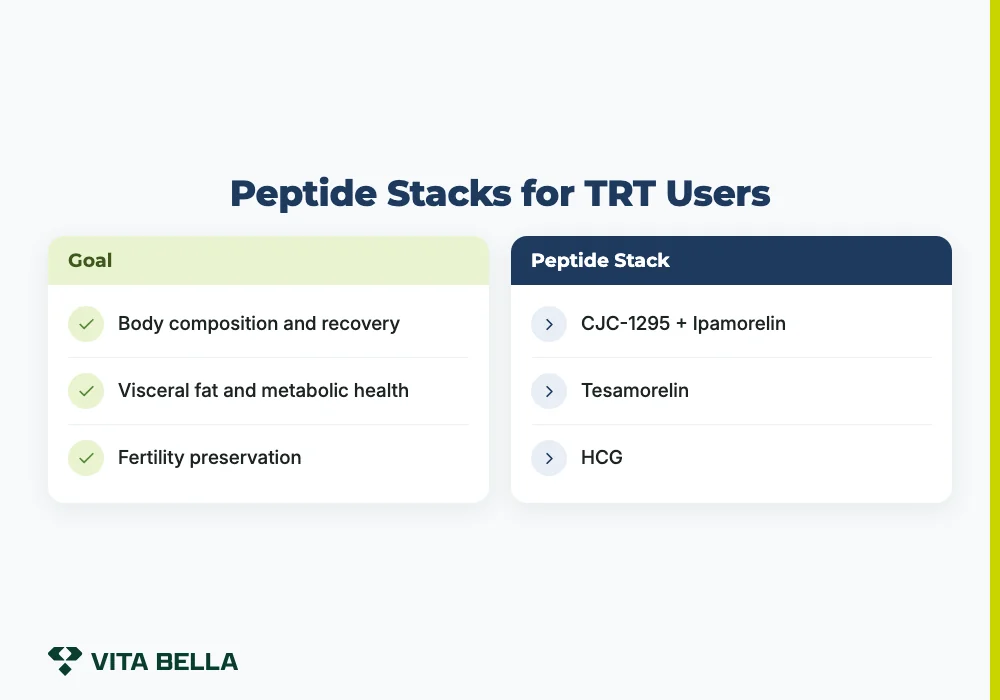
No single stack fits everyone. Goals, lab values, and clinical judgment all shape the protocol. That said, three combinations appear consistently in clinical practice:
- Body composition and recovery: CJC-1295 + ipamorelin TRT stack alongside testosterone, with IGF-1 tracked at baseline and periodically thereafter.
- Visceral fat and metabolic health: Tesamorelin and testosterone, with IGF-1 and metabolic markers monitored over time.
- Fertility preservation: HCG testosterone fertility support. Lee and Ramasamy (2019) found that low-dose HCG co-administered with testosterone replacement maintains intratesticular testosterone and preserves spermatogenesis over one year.
Reviewing your baseline markers before starting a combination helps providers individualize dosing from day one. Understanding the essential markers to track before a hormone or peptide protocol shapes how that individualization happens.
Does combining peptides with TRT cause side effects?
Side effects are possible, and manageable. Testosterone therapy can suppress LH and FSH, reducing sperm production, which is exactly what HCG is used to offset. Growth hormone releasing peptides may cause mild water retention at higher activity levels, and providers track IGF-1 along with metabolic markers to catch changes early.
The 2018 AUA guideline (Mulhall et al.) recommends regular monitoring during testosterone therapy. That framework extends naturally to any peptide additions.
Labs aren't a formality. They quantify what's actually happening, letting providers adjust before problems develop rather than after.
Start your protocol
Peptides with TRT work best as part of a coordinated plan built around your specific lab values and goals. Vita Bella's providers design and adjust each protocol at quarterly provider check-ins, using pharmaceutical-grade compounds from FDA-inspected U.S. pharmacies.
Frequently asked questions
CJC-1295 and ipamorelin target GH release and complement TRT for muscle recovery and body composition. Tesamorelin adds IGF-1 elevation and visceral fat reduction. HCG addresses gonadotropin suppression and supports fertility.
Yes, peptides and testosterone operate through separate pathways and can be combined safely under provider supervision. A licensed provider determines appropriate dosing after reviewing labs and adjusts the plan at quarterly provider check-ins.
Tesamorelin stimulates GH and IGF-1 through the pituitary, adding metabolic and recovery benefits that testosterone does not provide directly. Clinical data confirms it reduces visceral fat while supporting lean mass. Combined with TRT, it creates hormone optimization across multiple axes.
Side effects are manageable with proper monitoring. Testosterone suppresses natural gonadotropin signals, which peptides like HCG help offset. Regular tracking of IGF-1, testosterone, and metabolic markers lets providers adjust before issues escalate.
Sources
- Clemmons DR et al. (2017). Safety and metabolic effects of tesamorelin, a growth hormone-releasing factor analogue, in patients with type 2 diabetes: A randomized, placebo-controlled trial. PLOS ONE. PubMed
- Ditta AM et al. (2026). Efficacy and Safety of Tesamorelin in People Living With HIV With Lipodystrophy: A Systematic Review and Meta-Analysis. Journal of the International Association of Providers of AIDS Care. PubMed
- Badran AS et al. (2026). Body composition, hepatic fat, metabolic, and safety outcomes of Tesamorelin, a GHRH analogue, in HIV-associated lipodystrophy: A meta-analysis of randomized controlled trials. Obesity Research & Clinical Practice. PubMed
- Bhasin S et al. (2018). Testosterone Therapy in Men With Hypogonadism: An Endocrine Society Clinical Practice Guideline. The Journal of Clinical Endocrinology and Metabolism. PubMed
- Mulhall JP et al. (2018). Evaluation and Management of Testosterone Deficiency: AUA Guideline. The Journal of Urology. PubMed
- Lee JA & Ramasamy R (2019). Indications for the use of human chorionic gonadotropic hormone for the management of infertility in hypogonadal men. The World Journal of Men's Health. Source