Peptides legality in the US follows one clear rule: the more biologically active a peptide is, the more strictly the FDA regulates it. Most therapeutic peptides require a prescription from a licensed provider. Collagen is the exception. If you want to explore legal, provider-supervised options, get started with Vita Bella before ordering anything from an unverified source.
Are peptides legal in the US?
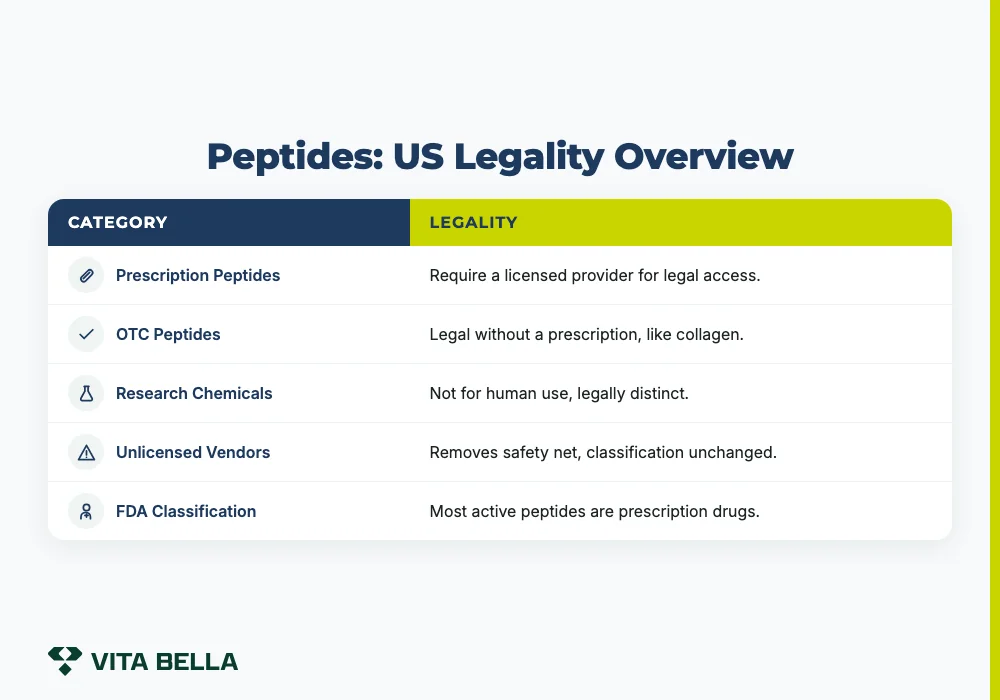
Yes. Peptides are legal in the US, but legality depends on which compound you're discussing and how you obtain it. The FDA classifies most biologically active peptides as prescription drugs because of their potent effects on specific biological pathways. Buying one from an unlicensed vendor does not change that classification. It only removes the safety net.
Peptides legality by category
| Category | Examples | Legal without a prescription? |
|---|---|---|
| Prescription therapeutic peptides | Semaglutide, tesamorelin, BPC-157 | No |
| Over the counter peptides | Collagen hydrolysates, cosmetic peptides | Yes |
| Research chemical peptides | Many injectable compounds sold online | Not for human use |
Prescription peptides are only legal through a licensed provider. Collagen and similar supplement-class compounds require no prescription, but they carry no pre-market efficacy review before reaching shelves. Compounds sold under "research chemical" labels occupy a legally distinct zone covered in detail below.
Can you buy peptides without a prescription?
Some peptides are available without a prescription. Most therapeutic ones are not. Compounds available without a prescription are limited to those classified as dietary supplements or cosmetics, with collagen as the most common example. These products are not subject to pre-market drug approval. In practice, no regulatory body has verified whether they work, only whether they are unsafe enough to pull from shelves.
Therapeutic peptides that affect hormones, tissue repair, or metabolism carry peptide prescription requirements because they interact with specific biological systems in ways that depend on your individual labs and health history. Without a licensed provider reviewing those results, there is no reliable way to know whether a compound is appropriate for you, what form it should take, or how dosing should be adjusted over time.
That provider-patient relationship is also what makes compounding pharmacy peptides legal. A state-licensed compounding pharmacy prepares the compound for a specific prescription under pharmaceutical-grade manufacturing standards. Peptides without prescription from unverified online vendors skip every one of those safeguards. The compound may not have been reviewed by a pharmacist, produced in conditions that would pass a state inspection, or even contain what the label claims.
A 2026 paper in Missouri Medicine examined injectable "biohacking" drugs purchased outside medical channels and found documented adverse events: contamination, mislabeling, and infections that required hospitalization (Moiz et al., 2026).
Which peptides have completed clinical review for specific medical uses?
Certain peptides have completed clinical trials and been cleared for specific medical conditions. Semaglutide (sold as Ozempic and Wegovy) went through the full drug review process for type 2 diabetes and chronic weight management. Tesamorelin (sold as Egrifta) was cleared for HIV-associated lipodystrophy. If you are weighing growth hormone peptide options, the clinical differences between tesamorelin and sermorelin are worth reviewing before committing to a protocol.
Many buyers conflate compounded peptides with brand-name drugs that have cleared full clinical review. They are not the same. Compounding pharmacy peptides are prepared pursuant to a valid prescription at a state-licensed pharmacy, but the compounded product has not undergone independent drug review as a finished product. Knowing which category applies is the starting point for any honest conversation about peptides legality.
Are research chemical peptides legal to purchase?
Research chemical peptides are not cleared for human use. Vendors label them "for laboratory research only" to sidestep drug regulation. That label is not a legal shield. It offers no protection from FDA enforcement. The regulatory test the FDA applies is intent of use, not how a vendor chooses to label the product.
The FDA has issued warning letters and taken enforcement action against vendors selling unapproved peptides under this framing. Peptides legality under the "research chemical" label is not a protection; it is a technicality the FDA has increasingly contested.
Health risk compounds the legal exposure. Without pharmaceutical-grade manufacturing standards, these compounds may contain contaminants, incorrect concentrations, or entirely different substances than what the label states. Moiz et al. (2026) documented hospitalizations linked to injectable drugs obtained from unregulated online channels, including products found to be mislabeled entirely.
Do you need a doctor to use peptides safely?
Yes. Peptide prescription requirements exist because therapeutic peptides interact with the endocrine system, immune response, and tissue repair pathways in ways that vary by individual. A licensed provider reviews your labs first, then determines the appropriate approach based on those results. Adjustments happen over time.
Self-administering a peptide without oversight is where peptides legality and patient safety intersect most sharply. No research chemical label shields you from a contaminated vial, an incorrect compound, or an adverse interaction with a condition you did not know you had.
Working through a licensed provider means your compound is prepared at FDA-inspected, state-licensed U.S. pharmacies, with discreet shipping and professional oversight at every stage. Recovery peptides look different when prescribed and monitored. The protocol is reviewed by a provider who ordered your labs, checked your history, and can adjust the approach when needed. Learn more about how peptides support recovery in provider-guided programs.
Ready to find out which peptides are right for you?
Peptides legality does not have to be confusing. Vita Bella connects you with licensed providers across 47 states who evaluate your labs, confirm clinical eligibility, and prescribe only compounds that meet current regulatory standards.
Frequently asked questions
No. Peptides signal your body to produce or release its own hormones naturally, while steroids introduce synthetic hormones directly. The mechanisms differ, and so do the risk profiles. Both categories require medical oversight for safe use.
Over the counter peptides like collagen are legal to purchase online. Therapeutic peptides require a valid prescription and must come from a licensed compounding pharmacy. Purchasing prescription-class peptides from unlicensed vendors removes every legal and safety protection.
Unregulated injectable peptides are not cleared for human use, and their quality is unverified. Documented risks include contamination, mislabeling, and infections requiring hospitalization, as found in a 2026 review in Missouri Medicine (Moiz et al., 2026). A licensed provider and a compounding pharmacy are the only reliable path to safe peptide use.
Most therapeutic peptides carry peptide prescription requirements and must be prescribed by a licensed provider. Collagen and similar supplement-class compounds are the exception. Your provider determines eligibility based on your labs and health history, not on symptoms alone.
Only compounds that have completed the full drug review process for a specific medical condition, such as semaglutide or tesamorelin, carry that level of regulatory authorization. Compounded preparations and supplement-class compounds do not go through this process. A licensed provider can clarify which category applies to any compound you are considering.
Sources
- Moiz A et al. (2026). Dangers of Injectable Peptides and Other Unregulated "Biohacking" Drugs. Missouri Medicine. PubMed