CJC-1295 ipamorelin dosage is not a single fixed number. A licensed provider determines it based on your health history, goals, and, where recommended, baseline labs. These two peptides work through complementary mechanisms: CJC-1295 amplifies each natural GH pulse while ipamorelin triggers additional pulsatile bursts through separate receptor pathways, and the right peptide stacking protocol depends on which goals you are targeting.
How CJC-1295 and ipamorelin work
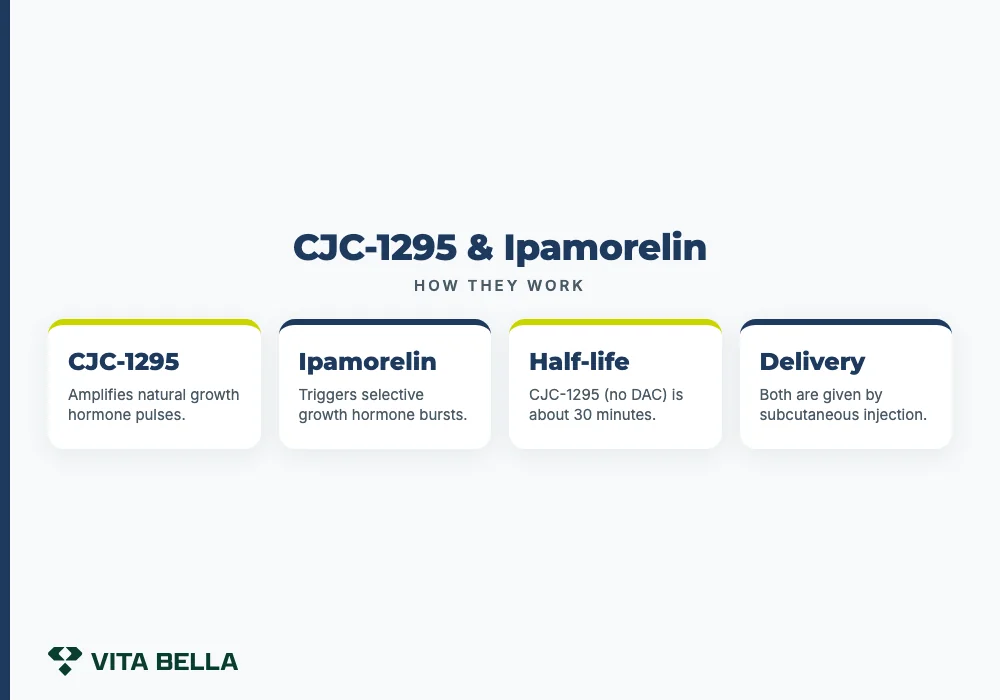
CJC-1295 is a GHRH analogue. It binds growth hormone-releasing hormone receptors in the pituitary, amplifying the GH pulse your body would have produced on its own. The version available through Vita Bella contains no drug affinity complex (DAC). That distinction matters.
The DAC version studied by Teichman et al. (2006) in JCEM binds albumin, extending the half-life to several days and producing sustained IGF-1 elevation. Without DAC, the half-life is approximately 30 minutes. Each injection amplifies one GH pulse. Effects build through consistent, regular dosing, not through a prolonged depot.
Ipamorelin is a growth hormone secretagogue. Raun et al. (1998) described it in the European Journal of Endocrinology as the first selective GHRP compound, producing minimal effects on cortisol, prolactin, and ACTH even at amounts far above the GH-stimulating threshold. That selectivity is why it anchors most GH secretagogue stacks.
| Property | CJC-1295 (no DAC) | Ipamorelin |
|---|---|---|
| Type | GHRH analogue | GH secretagogue (GHRP) |
| Half-life | ~30 minutes | Short-acting, pulsatile |
| Primary action | Amplifies natural GH pulse | Triggers selective GH bursts |
| Off-target hormone effects | Minimal | Minimal (highly selective) |
| Typical delivery | Subcutaneous injection | Subcutaneous injection |
Subcutaneous delivery bypasses gastrointestinal degradation, preserving bioactivity. Peptides are inherently unstable in aqueous environments, which is why formulation, storage temperature, and injection technique all affect how reliably the dose reaches the target receptor (Jain et al., 2019).
Can you stack CJC-1295 and ipamorelin together?
Yes. This is one of the most studied peptide stacking combinations for GH optimization. CJC-1295 provides a steady amplified foundation; ipamorelin adds discrete GH bursts through a separate ghrelin-receptor pathway. The two mechanisms layer rather than overlap, which is why the combined output exceeds either compound alone.
A 1999 study in Metabolism (Micić & Weffort) showed that combining GHRH analogues with GH secretagogues produces a greater GH response than either compound alone. Sigalos and Pastuszak's 2017 review in Sexual Medicine Reviews confirmed that GH secretagogues are generally well-tolerated and that stacking them with GHRH analogues reliably enhances GH output without a proportional increase in side effect risk.
The practical advantage of the stack is independent tunability. Each compound can be adjusted separately. If IGF-1 trends high, a provider can reduce ipamorelin frequency without changing CJC-1295. That granularity is harder with a single high-amount compound.
Not every goal requires both. Someone focused purely on fat metabolism may respond well to one compound. The provider assesses the clinical picture and adjusts the stack accordingly.
What is the best time to inject CJC-1295 and ipamorelin?
Ipamorelin injection timing follows the body's natural GH secretion pattern. The largest GH pulse of the day occurs during slow-wave sleep, making the window just before bed the highest-yield time for ipamorelin. Research on the DAC version of CJC-1295 by Ionescu and Frohman (2006) confirmed that pulsatile GH secretion continues even under sustained CJC-1295 stimulation, meaning the sleep window remains reliably targetable.
CJC-1295 without DAC has a half-life of roughly 30 minutes. It is co-administered with ipamorelin so both peaks overlap within the same GH release window.
Three timing patterns providers commonly build into the ipamorelin dosing schedule:
- Pre-sleep only. One injection of both compounds before bed. Targets the body's strongest natural GH pulse and suits most recovery, anti-aging, and general wellness goals.
- Pre-sleep and pre-training. Two injections daily. Exercise independently stimulates GH, and the pre-training injection can potentiate that effect, which is useful for body composition goals.
- Twice daily, evenly spaced. Morning and pre-sleep dosing for more distributed GH signaling across the day.
Insulin blunts GH release. Wang et al. (2022) document that the GH/IGF-1 axis responds dynamically to nutrient and metabolic signals, which is why injections are generally timed two hours from a large meal.
How often should you dose CJC-1295 with ipamorelin?
The CJC 1295 weekly protocol and ipamorelin dosing schedule are built as a pair. Daily injection of both compounds is the most common structure because it mirrors the body's natural GH pulsatility. Research on the DAC version of CJC-1295 by Ionescu and Frohman (2006) showed that pulsatile GH secretion is maintained with repeated dosing rather than progressively blunted, a finding that informs how daily no-DAC protocols are structured.
Providers set frequency based on goals and monitoring data:
- Once daily (pre-sleep). Standard starting structure for peptide therapy anti-aging, recovery, or general performance goals.
- Twice daily. Used for active individuals where daytime GH support is clinically warranted.
- Structured cycling. Periodic off-days or multi-month cycle breaks are sometimes included to preserve receptor sensitivity over longer programs.
The ipamorelin dosing schedule is reviewed at each quarterly provider check-in. IGF-1 data at that visit shapes whether frequency holds, increases, or is reduced.
What factors determine CJC-1295 ipamorelin dosage for first-time users?
Several variables shape the opening protocol for someone new to peptide therapy: baseline IGF-1, age, body composition, and any metabolic conditions that could alter GH sensitivity. A licensed provider weighs all of these before settling on a starting CJC-1295 ipamorelin dosage, which is why there is no reliable one-size answer a new user can look up in advance.
What dosage of ipamorelin is safe for beginners?
No universal starting number exists. Growth hormone secretagogue dosing is individualized because age, baseline GH output, body composition, and metabolic health all shift what is appropriate. A licensed provider determines the starting point after reviewing your health history. Labs are recommended to help calibrate the protocol from the first injection.
What research consistently confirms is that ipamorelin's selectivity provides a wider margin than older GH secretagogues. Raun et al. (1998) found that ipamorelin remained selective for GH with minimal cortisol and prolactin effects even at amounts far above the effective threshold. Starting lower and titrating based on response is standard practice regardless of prior experience with peptides.
How long does CJC-1295 ipamorelin take to work?
Early effects appear first. Improved sleep quality and faster post-exercise recovery are commonly reported in the initial weeks of consistent dosing. These reflect rising GH pulsatility. They are not the full benefit of the protocol.
Meaningful body composition changes require sustained signaling over time. Because each no-DAC CJC-1295 injection amplifies a single GH pulse rather than creating a prolonged depot, effects accumulate through regular dosing. IGF-1, as Laron (2001) documents in Molecular Pathology, is the central mediator of GH's anabolic and metabolic effects; one pulse does not shift body composition, but months of consistent GH signaling can.
Because the no-DAC formulation depends on repeated pulsatile stimulation, the CJC-1295 ipamorelin dosage set by your provider is designed to accumulate effect over weeks and months rather than produce a single large spike.
Several factors shape how quickly results appear:
- Sleep quality. GH pulses are largest during deep, slow-wave sleep. Disrupted sleep limits the window ipamorelin has to work within.
- Nutrition. Wang et al. (2022) document that the GH/IGF-1 axis responds to nutrient status and metabolic signals. Severe caloric restriction or significant insulin resistance can limit the response even with a well-structured protocol.
- Injection consistency. The no-DAC mechanism depends on regular dosing. Missed injections interrupt the cumulative GH pattern the protocol is designed to build.
- Age and baseline output. Those with lower baseline GH may notice subjective changes sooner. Absolute IGF-1 levels, however, remain the primary guide for adjustments.
What your provider evaluates before setting growth hormone secretagogue dosing
Several factors shape the initial CJC-1295 ipamorelin dosage decision. A licensed provider reviews the following before writing the first protocol.
IGF-1. This is the primary readout. As Laron (2001) documents, GH's downstream effects run largely through IGF-1, making it the clearest indicator of whether GH output is adequate, elevated, or suppressed before starting. Sinha et al. (2020) in Translational Andrology and Urology identify IGF-1 monitoring as the key variable for managing GH secretagogue protocols, particularly within a broader hormonal optimization program.
Fasting glucose and insulin. GH stimulation can shift glucose metabolism. A metabolic baseline confirms the protocol is safe to begin and gives a reference point for ongoing monitoring.
Thyroid panel. Undetected thyroid dysfunction blunts GH sensitivity and metabolic response. A baseline reading prevents misattributing a blunted result to the peptides themselves.
Cortisol. Ipamorelin is designed to leave cortisol unaffected. A baseline confirms the protocol is not landing on a pre-existing cortisol problem.
Labs are recommended rather than required for peptide protocols. They allow individualization from the first injection. Standard protocol parameters exist and are refined at the first quarterly provider check-in using your actual results. For detail on how providers structure multi-cycle peptide programs, that resource covers the design principles across longer treatment courses.
Safety monitoring and when to adjust
Two categories structure monitoring during an active CJC-1295 ipamorelin protocol: efficacy and safety.
Efficacy markers to track:
- IGF-1 trending toward the upper end of the reference range signals the protocol is producing the intended GH stimulus.
- Sleep depth, morning energy, and training recovery are tracked subjectively at quarterly check-ins.
- Body composition measurements confirm whether fat mass and lean tissue are moving in the expected direction.
Safety signals that trigger a protocol review:
- IGF-1 above the upper reference limit means the combined GH stimulus is too high. Providers typically reduce injection frequency before adjusting the per-injection amount.
- Joint stiffness or fluid retention are classic markers of GH excess and warrant prompt assessment.
- Fasting glucose rising above baseline requires a metabolic review before continuing.
- Fatigue in place of improved energy suggests a competing factor, such as sleep quality, nutrition, or thyroid function, is limiting the response.
Sigalos and Pastuszak (2017) note that long-term human data on GH secretagogues remains limited, which is why quarterly provider check-ins and structured cycle breaks are standard. The broader hormonal picture also matters: cellular aging, NAD+ availability, and metabolic resilience all interact with how the GH/IGF-1 axis responds across a multi-year program.
Peptide therapy, anti-aging, and the longer view
CJC-1295 ipamorelin dosage in peptide therapy anti-aging programs is calibrated to restore GH pulsatility toward ranges consistent with younger physiology. The goal is not supraphysiological GH output. It is measured signaling that supports metabolic health, tissue repair, and energy over time.
Sinha et al. (2020) document that GH secretagogues play a meaningful role in body composition management, supporting their use as one component of a comprehensive hormone therapy approach rather than as a standalone intervention. The research suggests that peptide protocols work best when paired with consistent monitoring rather than run independently.
Long-term programs typically include annual IGF-1 reassessment alongside quarterly symptom reviews. An oral GH secretagogue, MK-677, is sometimes compared to injectable ipamorelin for convenience. The two share a ghrelin-receptor mechanism but differ in delivery kinetics and side effect profile. How MK-677 compares to injectable GH secretagogues covers those distinctions for anyone weighing both options.
Start your protocol with a provider
CJC-1295 ipamorelin dosage decisions belong with a licensed provider who reviews your goals and health history before the first injection. Vita Bella connects you with providers across 47 states, offering quarterly check-ins, recommended labs, and a protocol built around your specific situation. Get Started to take the first step.
Frequently asked questions
Labs are recommended rather than required for peptide protocols. A provider can establish a standard ipamorelin dosing schedule based on your health history and goals, then use your response in the first weeks as a guide. Baseline labs help individualize the protocol from the start and are ordered and reviewed separately from the membership.
CJC-1295 with DAC binds albumin to extend its half-life to several days, producing sustained IGF-1 elevation with less frequent dosing. Without DAC, the half-life is approximately 30 minutes and each injection amplifies a single natural GH pulse. The no-DAC version requires consistent daily dosing, with effects accumulating through repeated pulsatile stimulation over time.
A licensed provider reviews IGF-1 levels, sleep quality, energy, and recovery at quarterly check-ins. If IGF-1 trends above the reference range or symptoms of GH excess appear, injection frequency is typically reduced before the per-injection amount changes. Consistent lab monitoring and accurate symptom reporting make the adjustment process more precise.
Adults targeting recovery, body composition, energy, or peptide therapy anti-aging outcomes are typical candidates. Those with active malignancy, significant uncontrolled insulin resistance, or unmanaged thyroid conditions will have those issues addressed before starting a protocol. A provider assessment determines fit based on your complete health history.
Published evidence, including the 2017 safety review by Sigalos and Pastuszak, indicates that GH secretagogues are generally well-tolerated within studied dose ranges. Long-term human data remains limited, making quarterly provider check-ins and structured cycle breaks standard practice in ongoing peptide therapy anti-aging programs.
Sources
- Raun K et al. (1998). Ipamorelin, the first selective growth hormone secretagogue. European Journal of Endocrinology. PubMed
- Micić D & Weffort RFVB (1999). Growth hormone response to GH-releasing peptide-6 and GH-releasing hormone in normal-weight and overweight patients with non-insulin-dependent diabetes mellitus. Metabolism. PubMed90115-4)
- Teichman SL et al. (2006). Prolonged stimulation of growth hormone and insulin-like growth factor I secretion by CJC-1295 [DAC version], a long-acting analog of GH-releasing hormone, in healthy adults. Journal of Clinical Endocrinology & Metabolism. PubMed
- Ionescu M & Frohman LA (2006). Pulsatile secretion of growth hormone persists during continuous stimulation by CJC-1295, a long-acting growth hormone-releasing hormone analog. Journal of Clinical Endocrinology & Metabolism. PubMed
- Laron Z (2001). Insulin-like growth factor 1 (IGF-1): a growth hormone. Molecular Pathology. PubMed
- Jain D et al. (2019). A review on parenteral delivery of peptides and proteins. Drug Development and Industrial Pharmacy. PubMed
- Sigalos JT & Pastuszak AW (2017). The safety and efficacy of growth hormone secretagogues. Sexual Medicine Reviews. PubMed
- Sinha DK et al. (2020). Beyond the androgen receptor: the role of growth hormone secretagogues in the modern management of body composition in hypogonadal males. Translational Andrology and Urology. PubMed
- Wang L et al. (2022). Therapeutic peptides: current applications and future directions. Frontiers in Pharmacology. PubMed