
Epitalon peptide is a synthetic tetrapeptide (Ala-Glu-Asp-Gly) developed from epithalamin, an extract of the pineal gland. In lab studies, it switches on telomerase, the enzyme that adds length to the protective caps at chromosome ends. A 2025 study in Biogerontology by Al-Dulaimi et al. found longer telomeres in four human cell lines after epitalon exposure, two normal and two breast cancer lines. In animal research and one small human study, epitalon was also linked to higher melatonin output, although the human study measured melatonin markers, not sleep. For people exploring peptide therapy for anti-aging support, epitalon is a peptide with early research on telomeres and melatonin, most of it from cell and animal studies, and neither area has yet been confirmed as an anti-aging benefit in people.
What does epitalon peptide do?
Research on epitalon peptide focuses on two separate mechanisms. The first is telomere maintenance: in cell-culture studies, it switched on telomerase in human cells that normally keep this enzyme turned off, such as fibroblasts. The second is circadian regulation: in animal studies and one small human study, it was linked to higher melatonin output. Both mechanisms matter for aging biology, but neither has been shown to slow aging in people.
A 2003 paper in the Bulletin of Experimental Biology and Medicine by Khavinson et al., from the St. Petersburg research group that developed epitalon, was the first to report telomerase activation and telomere elongation in cultured human fetal fibroblasts exposed to epitalon. The 2025 Biogerontology study by Al-Dulaimi et al., from an independent lab, tested two normal human cell types (fibroblasts and mammary epithelial cells) and two breast cancer cell lines. In the normal cells, epitalon raised telomerase activity and lengthened telomeres. In the cancer cells, telomeres also lengthened, but through a different route called alternative lengthening of telomeres (ALT).
These results come from cells grown in a lab dish. Because telomere maintenance also plays a role in cancer biology, an independent 2026 review in the International Journal of Molecular Sciences (Jain et al., 2026) lists oncologic safety among the unresolved questions and describes epitalon as biologically active but clinically unproven. Animal studies and well-designed human trials are still needed to show whether these cell findings matter in living people.
Telomere biology: why chromosome-end length matters for cells
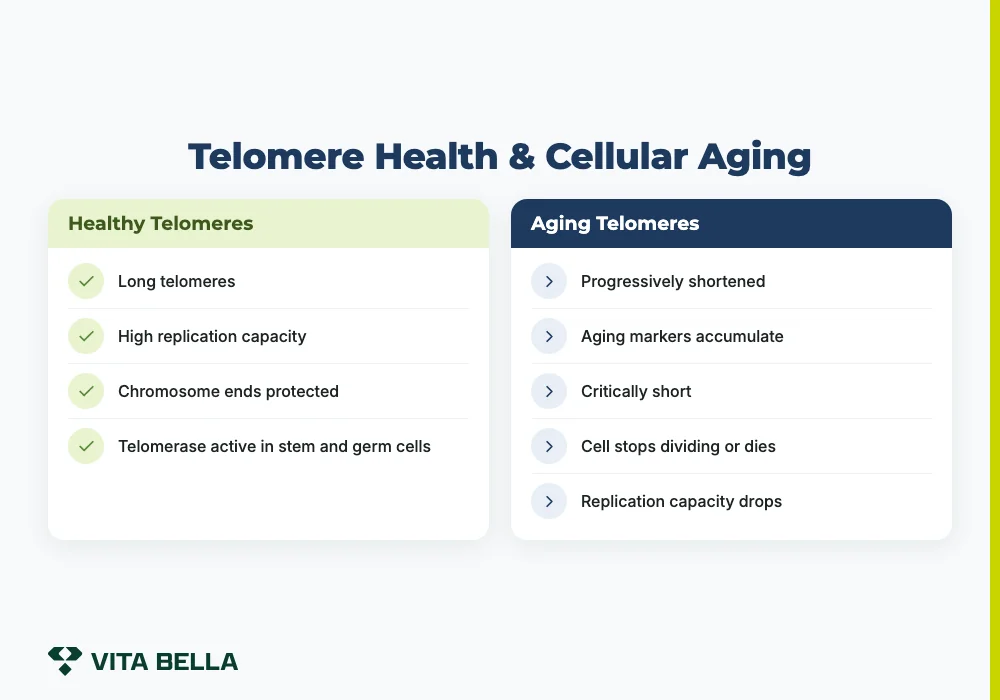
Telomeres are repetitive DNA sequences at chromosome ends. Their job is to protect genetic material during cell division, absorbing the shortening that occurs each time a chromosome is copied. When telomeres reach a critical shortness, the cell stops dividing or dies.
| Telomere status | Biological significance |
|---|---|
| Long | High remaining replication capacity |
| Progressively shortened | Each cell division trims a little more sequence |
| Critically short | Cell enters senescence or apoptosis |
| Maintained by telomerase | Telomerase adds sequence back; it is naturally active in stem cells and germ cells |
A 2014 review in the Journal of Cellular Physiology by Zhao et al. explains that telomeres maintain chromosome stability and the ability of cells to keep dividing, that telomere shortening occurs alongside aging, and that very short telomeres are linked to some diseases, such as dyskeratosis congenita, idiopathic pulmonary fibrosis, and aplastic anemia.
Telomerase is the natural counterbalance. Most adult body cells keep it switched off, and because about 90% of human cancers switch telomerase back on, researchers study telomerase activators for both potential benefit and long-term safety (Al-Dulaimi et al., 2025). Research on epitalon peptide is one example of how scientists are testing telomerase activation as an aging target, so far mostly in cell studies. Epitalon is a peptide, not a dietary supplement, and its description as a telomerase activating peptide comes from these lab studies.
How does epitalon affect telomere length?
In cell studies, epitalon peptide lengthened telomeres by raising expression of the telomerase gene (hTERT), not by supplying raw building materials. In the 2025 Biogerontology study by Al-Dulaimi et al., normal fibroblasts and mammary epithelial cells showed higher hTERT expression and telomerase activity. In two breast cancer cell lines, telomeres lengthened through the ALT pathway instead, while the normal cells showed only a minor increase in ALT activity.
The earlier 2003 report by Khavinson et al. found telomerase activation in cultured human fetal fibroblasts, cells that normally lack telomerase activity. It came from the research group that developed epitalon, and the 2025 Al-Dulaimi study is one of the few independent lab tests of this effect.
Telomere lengthening with epitalon has been reported in cell cultures, not in clinical trials in people; human evidence so far is limited to small physiological or biomarker studies (Jain et al., 2026). Epitalon telomere research is therefore still at the laboratory stage.
Can epitalon improve sleep quality?
Research has not tested this directly yet. Early studies suggest epitalon may support the pineal gland's own melatonin output, but the human study measured melatonin markers and gene activity, not sleep.
A 2025 review in the International Journal of Molecular Sciences by Araj et al. summarizes that study, which enrolled 75 women and included placebo and control groups. It came from the same St. Petersburg institute. In people with reduced melatonin output, sublingual epitalon raised a urine marker of the body's melatonin production about 1.7 times and shifted the activity of several clock genes in blood cells (Ivko et al., 2020). Because sleep itself was not measured, the study shows a change in melatonin markers rather than better sleep. Interest in pineal gland peptide therapy and in epitalon melatonin effects rests on this early work.
Night-shift work and some health conditions can disrupt melatonin output and circadian gene activity. Melatonin taken by mouth adds the hormone directly, while epitalon research looks at the gland's own output. No study has compared the two directly, so any difference between them is still a hypothesis.
What is the recommended epitalon dosage?
There is no universal dosage for epitalon, and pharmacokinetic and dose-ranging data in people remain inadequate (Jain et al., 2026). When a licensed provider considers an epitalon peptide protocol, the starting point is a review of health history, current medications, and goals.
Several factors shape that decision:
- Age and health history: A provider considers your age, sleep patterns, and overall health when deciding whether epitalon fits and how to monitor your response.
- Route of administration: The 2025 review by Araj et al. notes that epitalon has mostly been studied as an injection, with smaller studies of sublingual use in people and intranasal use in animals. The form used shapes how a provider structures the protocol.
- Other peptide or hormone protocols: If you use other peptides or hormones, your provider reviews how they fit together. For background, see how structured peptide cycling works under provider oversight.
- Labs: Labs are recommended rather than required for peptide therapy; they help individualize dosing and give your provider measurable checkpoints on your overall health, alongside how you feel.
A licensed provider determines the dose and schedule. A fixed template applied to everyone would miss the variables that matter for each person.
Is epitalon peptide safe for anti-aging use?
Human safety data on epitalon are limited. Small human studies have reported few side effects, but they did not track safety in a systematic way, and the 2025 Biogerontology study was done in cell cultures, so it could not assess side effects in people. The 2025 review by Araj et al. notes that information on critical safety questions is missing from the published research and calls for studies of short- and long-term toxicity. An independent 2026 review adds that long-term safety data remain inadequate and that oncologic, immunogenicity, and product-quality questions are unresolved (Jain et al., 2026).
No large randomized controlled trials have been published, so a conservative, provider-monitored approach makes more sense than self-administration. Possible side effects may include mild injection-site reactions, such as redness or tenderness. Because safety has not been tracked systematically, a licensed provider monitors your response and adjusts the plan if needed.
Epitalon anti-aging research is focused and early. Current evidence shows effects on telomeres in cell cultures and on melatonin markers in animal studies and one small human study; no adequately powered randomized trial has established therapeutic benefit (Jain et al., 2026). Claims about specific metabolic improvements or cosmetic changes are not substantiated by the current literature.
Epitalon longevity research: fitting it into a complete aging plan
Epitalon peptide is being studied for two processes linked to aging: telomere shortening and circadian rhythm. These sit alongside other drivers of aging that need separate attention, and no single compound covers them all. Epitalon longevity research has not yet shown an effect on lifespan or healthspan in people.
Where does epitalon peptide fit within a broader aging plan?
Hormone status is a separate part of an aging evaluation. A provider may review testosterone, thyroid, and other hormone levels alongside your symptoms and goals, because these systems can change with age independently of any peptide. This is why provider-led care at Vita Bella evaluates these systems together rather than in isolation, building a plan around your full health picture.
If you use more than one peptide, your provider reviews how the compounds interact, including timing and cycling, because self-managed combinations can miss these details.
Your lab results are one input your provider reads alongside your symptoms and goals, including results that fall within the standard reference range. Understanding how lab values relate to real health outcomes beyond standard reference ranges can help you talk through your results with your provider.
Sleep habits, stress, and metabolic health also matter in aging, and the surrounding plan, including hormone evaluation, lifestyle structure, and regular provider check-ins, shapes the overall approach.
Ready to explore peptide therapy?
If epitalon or other anti-aging treatment options fit your health goals, the right first step is a provider evaluation. A licensed clinician reviews your health history, baseline, and goals before recommending any protocol. At Vita Bella, every plan is designed by a licensed provider and adjusted as your response develops over time.
Frequently asked questions
Epitalon peptide is a synthetic tetrapeptide studied for two effects. In cell cultures, it switched on telomerase and lengthened telomeres. In animal research and one small human study, it was linked to higher melatonin output. These are early findings that clinical trials in people have not yet confirmed.
In cell studies, epitalon raised telomerase activity and lengthened telomeres in normal human fibroblasts and mammary epithelial cells by raising activity of the telomerase gene (hTERT). In two breast cancer cell lines, telomeres also lengthened, through a different pathway called ALT. These lab findings have not been tested in people, and independent reviewers list oncologic safety as an unresolved question.
Early research suggests epitalon may support melatonin output, but sleep quality has not been measured yet. In one small study, people with reduced melatonin output who took sublingual epitalon had higher urinary melatonin markers (Ivko et al., 2020). Its effect on sleep onset and sleep stages is still unknown.
There is no universal dosage for epitalon, and dose-ranging data in people remain inadequate. A licensed provider determines the amount and schedule based on your age, health history, goals, and any other peptide or hormone protocols you use. Labs are recommended rather than required for peptide therapy; they help individualize dosing and provide measurable checkpoints over time.
Human safety data on epitalon are limited: small studies reported few side effects, but safety was not tracked systematically and long-term data are not available. Possible side effects may include mild injection-site reactions, and a licensed provider monitors your response and adjusts the plan if needed.
Sources
- Khavinson V. K., Bondarev I. E., Butyugov A. A. (2003). Epithalon peptide induces telomerase activity and telomere elongation in human somatic cells. Bulletin of Experimental Biology and Medicine. PubMed
- Al-Dulaimi S. et al. (2025). Epitalon increases telomere length in human cell lines through telomerase upregulation or ALT activity. Biogerontology (correction published 2025). PubMed
- Zhao Z. et al. (2014). Telomere length maintenance, shortening, and lengthening. Journal of Cellular Physiology. PubMed
- Araj S. K., Brzezik J., Mądra-Gackowska K., Szeleszczuk Ł. (2025). Overview of Epitalon, highly bioactive pineal tetrapeptide with promising properties. International Journal of Molecular Sciences. PMC
- Ivko O. M. et al. (2020). AEDG peptide regulates human circadian rhythms genes expression during pineal gland accelerated aging. Advances in Gerontology. PubMed
- Jain A. et al. (2026). Epitalon and Epithalamin: A Narrative Review of Mechanistic, Preclinical, and Clinical Evidence. International Journal of Molecular Sciences. PubMed