A skin radiance treatment targets dullness, uneven tone, and surface texture at the cellular level. The right formula works differently from a standard moisturizer. It combines actives that drive collagen synthesis, neutralize free radicals, and accelerate cell turnover, delivering structural change instead of surface coverage. For a protocol calibrated to your skin type and goals, a skin care consultation with a provider puts the right formula in place from the start.
What ingredients improve skin radiance?
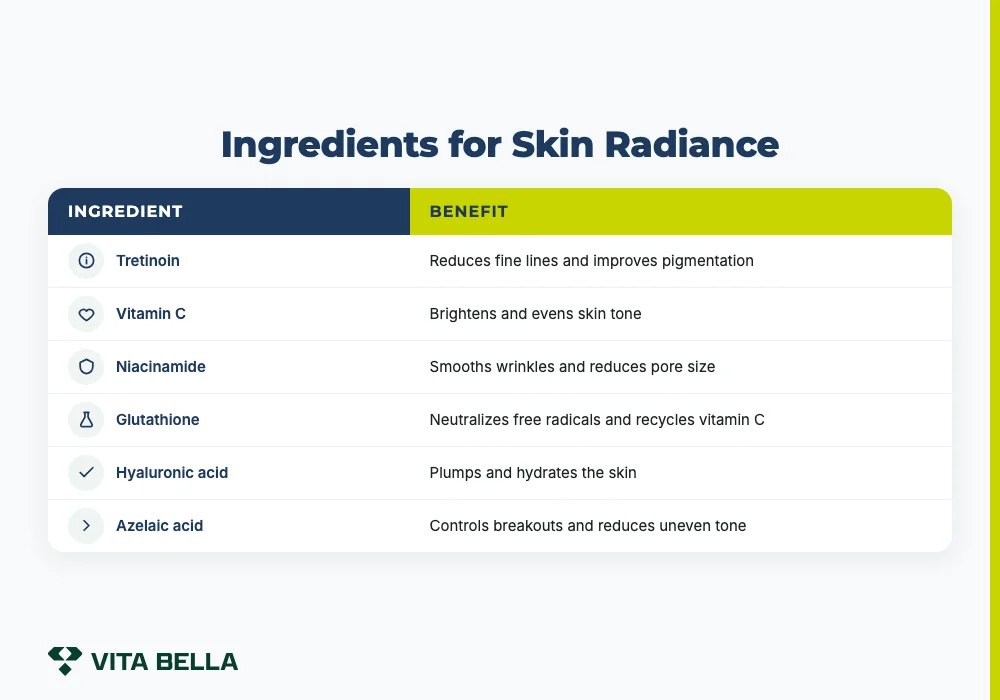
The most effective skin radiance treatment protocols layer ingredients that work through distinct mechanisms. One compound alone cannot address all causes of dull, uneven skin, which is why evidence-backed formulas combine several actives together.
| Ingredient | Primary function | Key benefit |
|---|---|---|
| Tretinoin | Cell turnover acceleration | Reduces fine lines, improves pigmentation |
| Vitamin C | Collagen synthesis | Brightens and evens skin tone |
| GHK-Cu | Tissue repair signaling | Improves elasticity and firmness |
| Niacinamide | Barrier reinforcement | Smooths wrinkles, reduces pore size |
| Glutathione | Master antioxidant | Neutralizes free radicals, recycles vitamin C |
| Hyaluronic acid | Moisture binding | Plumps and hydrates |
| Azelaic acid | Anti-inflammatory | Controls breakouts, reduces uneven tone |
| Caffeine | Vasoconstriction | Reduces puffiness, improves microcirculation |
A 12-week human trial documented by Harvard Health showed that vitamin C brightening skin formulas significantly improved fine lines, texture, and brightness. Nusgens et al. separately confirmed that topically applied vitamin C elevates collagen I and III mRNA levels in human dermis, explaining why a brightening face cream with vitamin C produces structural change rather than surface brightening alone.
The American Academy of Dermatology cites clinical evidence that tretinoin reduces fine lines, improves pigmentation, and increases collagen production. That combination makes tretinoin foundational in any skin renewal overnight formula, not an optional add-on.
Does glutathione brighten skin?
Yes. Glutathione for skin works at the cellular level by neutralizing the free radicals that drive oxidative stress. Oxidative stress directly causes melanin overproduction and uneven tone. When that load drops, the skin maintains a more even, consistent complexion over time.
The amplification effect matters. Glutathione recycles both vitamin C and vitamin E after each antioxidant reaction, extending their protective window. Using glutathione for skin alongside these brightening products produces a more sustained brightening result than either ingredient used separately. Vita Bella's glutathione resource covers how it integrates into a full skin radiance treatment plan.
How do you get radiant skin?
Radiant skin comes from applying proven actives consistently, twice daily, over at least eight to twelve weeks. Build this structure: a complete skin radiance treatment routine covers morning protection, overnight repair, targeted eye care, and systemic antioxidant support.
- Morning: Vita Bella's Sole Day Cream combines vitamin C brightening skin benefits, azelaic acid for anti-inflammatory resilience, NAD+, and hyaluronic acid. This brightening face cream builds a consistent baseline of protection and tone improvement with daily use.
- Night: Luna Night Cream combines tretinoin and GHK-Cu for skin renewal overnight with niacinamide and estriol for barrier reinforcement. Applied nightly, this anti-aging skin cream targets structural changes during the body's natural recovery window.
- Daytime collagen support: Luminosa Glow Cream adds GHK-Cu, NAD+, niacinamide, and azelaic acid for collagen-boosting support that sustains the renewal work started overnight.
- Eye care: Puffy Eye Cream applies caffeine, niacinamide, and hyaluronic acid to reduce puffiness and strengthen the under-eye barrier. A PubMed-indexed study by Husein El Hadad et al. found that caffeine-infused topical creams reduce puffiness and improve microcirculation in human trials.
- Systemic support: Glutathione and NAD+ manage oxidative load and support cellular energy from within, strengthening the foundation that glowing skin products build on.
Rotating products every few weeks prevents cumulative benefit from developing. An anti-aging skin cream with tretinoin needs six to eight weeks before the collagen remodeling it triggers becomes visible. Consistency is what separates people who see change from people who do not.
Provider oversight helps when results plateau or the skin shows signs of irritation. The systemic factors that drive skin results from within are as relevant as the topical routine, particularly after 40 when hormonal shifts change how the skin responds to treatment.
What is the best night cream for glowing skin?
A night cream for glow that combines tretinoin, GHK-Cu, niacinamide, and an estrogen analog covers the main mechanisms behind age-related skin change. Tretinoin drives cell turnover and collagen synthesis. GHK-Cu supports elasticity and signals tissue repair. Niacinamide strengthens the skin barrier and addresses wrinkle depth. The estrogen analog compensates for the skin thinning that accelerates after age 35.
Vita Bella's Luna Night Cream uses this formulation. Applied nightly, this combination leverages the overnight recovery window to compound each ingredient's effect. An anti-aging skin cream at this formulation depth delivers skin renewal overnight in a way that simpler moisturizers cannot match. A licensed provider determines how to pair it with daytime glowing skin products to avoid cumulative over-exfoliation.
How long does skin radiance treatment take to work?
Initial improvements in texture and hydration from a skin radiance treatment typically appear in two to four weeks. Brightening takes longer. Vitamin C brightening skin formulas need six to eight weeks of daily application before tone-evening becomes visible. Structural improvements from tretinoin and GHK-Cu, including reduced fine lines and improved elasticity, build over twelve weeks and continue to compound with consistent use.
The twelve-week benchmark is not arbitrary. The Harvard Health-documented trial measured vitamin C over twelve weeks. AAD evidence for tretinoin spans similar periods. Setting expectations for visible collagen remodeling inside two weeks leads people to abandon effective treatment protocols before the structural change becomes visible.
If twelve weeks pass without visible improvement, a provider review can assess whether the formula needs adjustment or whether a systemic factor is limiting response. What to expect when tretinoin is part of a longer-term renewal plan is covered in detail for people working through that evaluation.
Glowing skin products also work faster when sleep and systemic health support the skin's repair cycle. High oxidative stress and poor sleep slow cell turnover regardless of what the formula contains.
Start your skin radiance treatment
A provider-guided plan removes the guesswork from ingredient selection, application frequency, and formula compatibility. Get Started to begin a personalized intake.
Frequently asked questions
Radiant skin requires consistent daily use of layered actives: vitamin C and azelaic acid in the morning, tretinoin and GHK-Cu at night. Eight to twelve weeks of daily application is the threshold where clinical evidence shows measurable structural change.
Tretinoin, vitamin C, GHK-Cu, niacinamide, and glutathione are the most evidence-backed ingredients for skin radiance. Each targets a different mechanism, from collagen synthesis to antioxidant defense, and their benefits compound when layered in a calibrated protocol.
Yes. Glutathione for skin reduces the oxidative stress that drives dullness and uneven melanin production. It also recycles vitamin C and vitamin E, extending their brightening effect. Combined with it, the result is a more sustained and even glow.
A night cream for glow combining tretinoin, GHK-Cu, niacinamide, and an estrogen analog addresses collagen loss, reduced cell turnover, barrier weakness, and declining skin estrogen. This formulation delivers skin renewal overnight in a way that simpler night creams do not match.
Initial texture and hydration improvements appear in two to four weeks. Brightening from vitamin C takes six to eight weeks. Structural changes from tretinoin and GHK-Cu build over twelve weeks, the benchmark period reflected in the clinical evidence on these ingredients.
Sources
- Harvard Health Publishing. Why is topical vitamin C important for skin health? Harvard Health. Harvard Health
- American Academy of Dermatology. Retinoids: skin care benefits. AAD. AAD
- Husein El Hadad et al. Caffeine as a Topical Agent: Benefits and Applications in Cosmetics. PubMed. PubMed
- Nusgens BV et al. Topically applied vitamin C enhances the mRNA level of collagens I and III, their processing enzymes, and tissue inhibitor of matrix metalloproteinase 1 in the human dermis. J Invest Dermatol. PubMed