HCG and TRT are often discussed together because testosterone therapy can lower sperm production. Human chorionic gonadotropin (HCG) mimics luteinizing hormone (LH), keeping the testes active while exogenous testosterone suppresses the pituitary signal. For men considering testosterone replacement therapy, testosterone fertility preservation starts with timing: guidelines advise against starting testosterone in men who are trying to conceive now, and small studies suggest low-dose HCG alongside TRT may help maintain sperm production in men who plan to have children later.
How does HCG work with testosterone replacement therapy?
Testosterone replacement therapy raises circulating testosterone by delivering it from outside the body. That exogenous signal feeds back to the hypothalamus and pituitary, suppressing the release of LH and follicle-stimulating hormone (FSH). Without LH, Leydig cells inside the testes stop producing testosterone locally. Sertoli cells, which depend on high intratesticular testosterone to support sperm development, lose that substrate. Sperm count drops.
HCG is a glycoprotein hormone, not a peptide. It binds the same LH receptor on Leydig cells and drives intratesticular testosterone production directly, bypassing the now-suppressed pituitary. A 2005 study by Coviello et al. in the Journal of Clinical Endocrinology and Metabolism found that in 29 men with normal reproductive function, testosterone alone lowered intratesticular testosterone by 94% over three weeks, while adding low-dose HCG kept it in the normal range; sperm production was not measured.
This is the clinical logic behind combining HCG and TRT: TRT sets circulating testosterone, while HCG supports testosterone production inside the testes. In a retrospective study of 26 hypogonadal men on TRT with low-dose HCG, semen parameters stayed stable and no man became azoospermic over an average follow-up of about six months (Hsieh et al., 2013).
What TRT does to sperm production without intervention
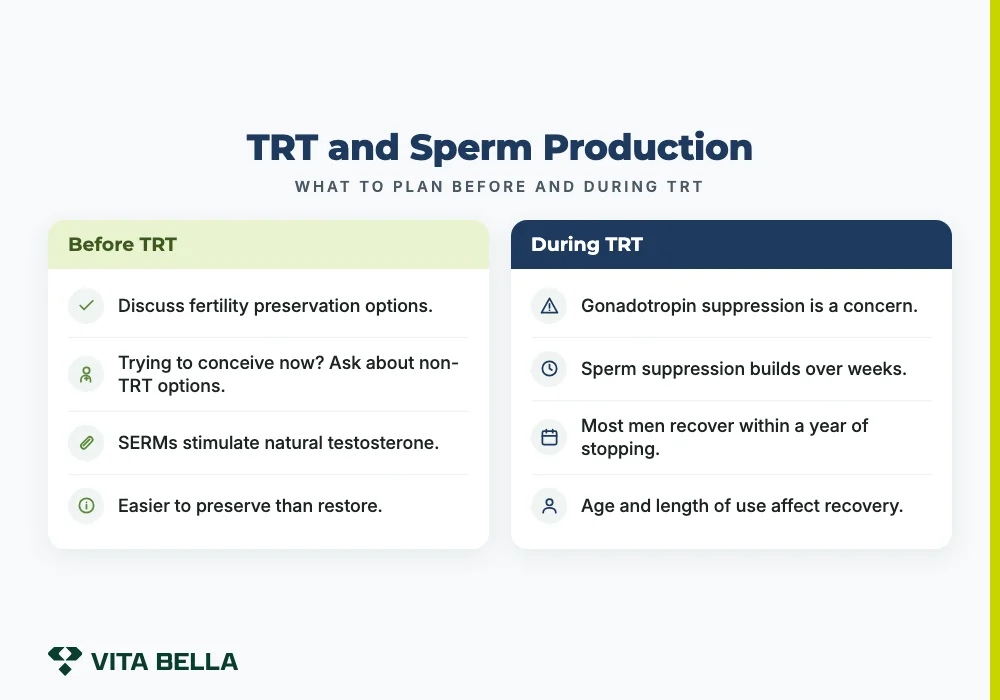
Because exogenous testosterone suppresses sperm production, the 2018 Endocrine Society Clinical Practice Guideline by Bhasin et al. recommends against starting testosterone therapy in men who are planning fertility in the near term. The 2018 AUA Guideline on testosterone deficiency, led by Mulhall et al., states that exogenous testosterone should not be prescribed to men who are currently trying to conceive, and that its long-term impact on sperm production should be discussed with men interested in future fertility.
The timeline matters. Sperm suppression builds over weeks to months as the pituitary adjusts to elevated circulating testosterone. After hormonal suppression stops, most men recover: in pooled data from 1,549 men in hormonal contraception studies, 67% were back to 20 million sperm per mL within 6 months and 90% within 12 months (Liu et al., 2006). Recovery tends to be slower with older age and longer testosterone use (Kohn et al., 2017), and a minority of men may stay azoospermic.
Preserving fertility on testosterone is easier than restoring it after the fact. That conversation belongs before the first dose, not after.
For more on managing sperm health during treatment, see fertility management on a testosterone protocol.
Options for fertility preservation before starting TRT
The 2018 Endocrine Society guideline recommends against starting testosterone therapy in men planning fertility in the near term, and the 2018 AUA Guideline lists HCG and SERMs among the options clinicians may use for men with testosterone deficiency who want to maintain fertility. The main paths a provider walks through are:
- HCG and TRT combined: Low-dose HCG supports Leydig cell activity while exogenous testosterone handles circulating T levels. Published protocols suggest it for men who want TRT now and children later, not for men trying to conceive now (Lee and Ramasamy, 2018).
- HCG without TRT: For men who want to conceive soon, HCG-based therapy can raise testosterone production inside the testes without exogenous testosterone (Lee and Ramasamy, 2018).
- SERMs alone (clomiphene or enclomiphene): These block estrogen feedback at the hypothalamus, raising the body's own LH and FSH. An option for men who want to raise their own testosterone without exogenous testosterone.
- Sperm banking before TRT: A safeguard that works alongside any hormone path. Useful for men who want a backup before starting a protocol.
Whether HCG and TRT fit together, or another path fits better, is a decision a licensed provider makes based on labs, symptom profile, and fertility goals. A baseline semen analysis before starting testosterone creates a reference point for monitoring.
Does HCG preserve fertility while on TRT?
It can, based on small studies. HCG for sperm production works because it acts directly on the Leydig cells via the LH receptor, independent of what the pituitary is doing. Adding low-dose HCG to a TRT protocol may help preserve fertility on testosterone by maintaining the testicular environment for spermatogenesis even as exogenous testosterone suppresses the gonadotropin signal. Over the longer term, some men may also need FSH support.
A 2018 review by Lee and Ramasamy in Translational Andrology and Urology called HCG a safe and effective alternative or adjunct to TRT for hypogonadal men who want to preserve fertility. For men hoping to conceive within about six months, it suggests stopping TRT and using HCG-based therapy; for men planning further out, continuing TRT with low-dose HCG.
Timing still matters. Planning for fertility before TRT, including a baseline semen analysis, gives a provider the most options. Men who have used testosterone for years can still respond to HCG-based therapy, but recovery tends to take longer with older age and longer use (Kohn et al., 2017), and sperm parameters may not fully return to baseline in every case.
Can HCG restore sperm count in men on testosterone?
It can help, usually after testosterone is stopped. In a retrospective study of 66 men with infertility after testosterone use, stopping testosterone and using HCG with a SERM brought 70% to a total motile sperm count above 5 million within 12 months; older men and longer users recovered more slowly (Kohn et al., 2017).
Recovery is not fast. Sperm production takes about 64 days from early germ cell to mature sperm in labeling studies (Heller and Clermont, 1963; Misell et al., 2006), so changes in sperm count lag behind hormonal changes by two to three months. A series of semen analyses over six months gives the clearest picture of response.
HCG raises intratesticular testosterone but does not replace FSH, which Sertoli cells need for full sperm production. Men whose counts stay low despite a confirmed HCG response may be evaluated for FSH supplementation, a step described in the 2018 Lee and Ramasamy review.
HCG hypogonadism treatment also applies to men who have never started TRT but whose gonadotropin output is insufficient. A 2019 retrospective case series by Madhusoodanan et al. in the International Brazilian Journal of Urology followed 20 men with symptoms and total testosterone above 300 ng/dL who used HCG alone: average testosterone rose from about 362 to 520 ng/dL, and half reported symptom improvement, with no adverse events recorded. For some men, HCG is the primary treatment path, not just an add-on to an HCG and TRT protocol.
What is the difference between HCG and Clomid for male fertility?
HCG acts directly on the Leydig cells inside the testes, binding the LH receptor and driving intratesticular testosterone production without needing the pituitary. Clomiphene works upstream at the hypothalamus, blocking estrogen receptors and raising the body's own LH and FSH production. Both pathways can support spermatogenesis, but the route is fundamentally different.
For men who stay on TRT, HCG is the main fertility-support option because it acts directly on the testes, bypassing the suppressed pituitary signal. Some published protocols also add clomiphene to HCG to support FSH (Lee and Ramasamy, 2018). For men who want to raise their own testosterone without exogenous testosterone, a SERM alone is another path.
Enclomiphene is a purified trans-isomer of clomiphene. If you are comparing options for natural testosterone support without TRT, the article on enclomiphene vs. clomiphene covers those trade-offs. For men who stay on a testosterone protocol, HCG is the most studied fertility-support add-on, though the evidence comes from small studies.
HCG for hypogonadism treatment: a broader role
Fertility is the most common reason HCG and TRT are discussed together, but HCG has a wider clinical application for men. A 2002 double-blind, placebo-controlled randomized trial by Liu et al. randomized 40 men over 60 with partial androgen deficiency to recombinant HCG or placebo for three months. HCG raised testosterone and added about 2 kg of lean body mass, but it did not improve muscle strength, physical function, or physical activity, and testis volume decreased. Beyond fertility, research on human chorionic gonadotropin men's health effects is smaller and mixed.
The Madhusoodanan case series is small and uncontrolled, and both the Endocrine Society and AUA guidelines define testosterone deficiency by consistently low testosterone plus symptoms, so a provider weighs these findings case by case. This matters for men whose symptoms and labs are out of sync. When total testosterone is near the lower limit of normal or SHBG may be altered, the 2018 Endocrine Society guideline recommends also measuring free testosterone, which can help explain that mismatch. See how SHBG affects free testosterone levels.
HCG can also help maintain testicular size during long-term testosterone therapy, a use described in the 2018 Lee and Ramasamy review. Testicular shrinkage is a known side effect of TRT. For some men, that is a quality-of-life concern independent of fertility, and including HCG in an HCG and TRT protocol may help limit it.
Is HCG safe for men using testosterone therapy?
HCG is generally well tolerated in men under medical supervision. The 2018 AUA Guideline lists HCG, along with SERMs and aromatase inhibitors, as options clinicians may use for men with testosterone deficiency who want to maintain fertility, a conditional recommendation based on lower-certainty evidence. The 2018 Lee and Ramasamy review describes HCG as a safe and effective option in this setting.
Possible side effects are uncommon at physiological doses. They may include breast tenderness or enlargement (linked to a rise in estradiol), headache, irritability or other mood changes, fluid retention, or discomfort at the injection site, and they typically resolve with protocol adjustment under provider oversight. A licensed provider determines the dose after reviewing labs and clinical history. Regular monitoring, including testosterone levels and semen analysis when fertility is the stated goal, keeps the protocol calibrated over time.
In male fertility hormone therapy, labs reviewed at baseline and rechecked during treatment help a provider adjust the plan. At Vita Bella, quarterly provider check-ins help keep an HCG and TRT protocol aligned with your goals as your body responds. If a provider prescribes HCG, members get wholesale pricing on medications, billed separately from the membership fee.
Who is a candidate for HCG alongside TRT?
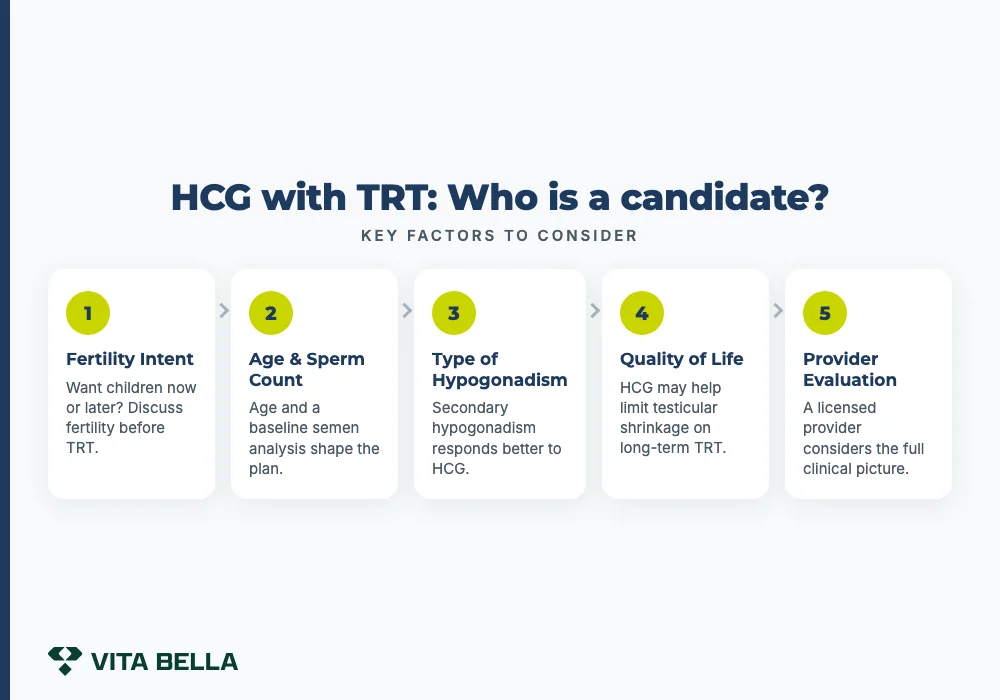
Not every man on TRT needs HCG, and the decision depends on factors a provider weighs during the initial evaluation.
Fertility intent is the clearest indicator. Any man who may want biological children, now or in the future, should discuss fertility before starting TRT. The 2018 Endocrine Society guideline recommends against starting testosterone therapy in men planning fertility in the near term, and the AUA guideline advises discussing testosterone's long-term impact on sperm production with men interested in future fertility.
Age and baseline sperm count shape the clinical picture. Age matters too: in men recovering sperm production after testosterone use, older age predicted slower recovery (Kohn et al., 2017). If a man has already completed his family, HCG may still be discussed for testicular health, but it is not a clinical requirement.
Type of hypogonadism matters. Men with secondary hypogonadism, where the testes are intact but the pituitary signal is insufficient, respond better to HCG than men with primary hypogonadism, where the testes themselves have reduced capacity. A thorough hormone panel distinguishes the two.
Quality of life is a legitimate factor as well. Testicular shrinkage is a known effect of long-term TRT. Some men find it significant; others do not. Including HCG in a protocol may help limit it.
None of these factors stands alone. A licensed provider evaluating someone for male fertility hormone therapy looks at the full picture before recommending a protocol. See interpreting hormone panels beyond standard ranges.
Ready to explore your options?
If you want to know whether HCG belongs in your hormone protocol, start with a provider who reviews your labs and your goals before making any recommendation. Get Started
Frequently asked questions
It can help. HCG binds the LH receptor on Leydig cells and can keep intratesticular testosterone up even when exogenous testosterone has suppressed the pituitary signal. In a small retrospective study, men on TRT with low-dose HCG kept stable semen parameters over about six months on average (Hsieh et al., 2013). Men trying to conceive now are usually advised not to use TRT at all.
It is possible, but less likely: TRT lowers LH and FSH, which reduces or stops sperm production in many men. Guidelines advise against TRT for men who are trying to conceive now. After TRT stops, most men's sperm counts return, typically within months, though older men and long-term users may take longer (Liu et al., 2006; Kohn et al., 2017).
HCG acts directly on the testes via the LH receptor, bypassing the pituitary. Clomiphene works upstream at the hypothalamus to raise the body's own LH production. For men who stay on TRT, HCG is the main option because it acts at the testes and bypasses the suppressed pituitary signal.
No. HCG is a glycoprotein hormone that stimulates the testes to produce testosterone; it does not deliver testosterone directly. TRT provides exogenous testosterone, while HCG keeps the testes active and contributing to both testosterone and sperm production.
A licensed provider weighing HCG and TRT together considers fertility goals, baseline labs including semen analysis when relevant, age, and type of hypogonadism. The dose a provider determines comes from reviewing those labs and monitoring clinical response over time.
Sources
- Bhasin S et al. (2018). Testosterone Therapy in Men With Hypogonadism: An Endocrine Society Clinical Practice Guideline. The Journal of Clinical Endocrinology and Metabolism. PubMed
- Mulhall JP et al. (2018). Evaluation and Management of Testosterone Deficiency: AUA Guideline. The Journal of Urology. PubMed
- Coviello AD et al. (2005). Low-dose human chorionic gonadotropin maintains intratesticular testosterone in normal men with testosterone-induced gonadotropin suppression. The Journal of Clinical Endocrinology and Metabolism. PubMed
- Lee JA, Ramasamy R (2018). Indications for the use of human chorionic gonadotropic hormone for the management of infertility in hypogonadal men. Translational Andrology and Urology. PubMed
- Madhusoodanan V et al. (2019). Human chorionic gonadotropin monotherapy for the treatment of hypogonadal symptoms in men with total testosterone > 300 ng/dL. International Brazilian Journal of Urology. PubMed
- Liu PY et al. (2002). A double-blind, placebo-controlled, randomized clinical trial of recombinant human chorionic gonadotropin on muscle strength and physical function and activity in older men with partial age-related androgen deficiency. The Journal of Clinical Endocrinology and Metabolism. PubMed
- Hsieh TC et al. (2013). Concomitant intramuscular human chorionic gonadotropin preserves spermatogenesis in men undergoing testosterone replacement therapy. The Journal of Urology. PubMed
- Liu PY et al. (2006). Rate, extent, and modifiers of spermatogenic recovery after hormonal male contraception: an integrated analysis. The Lancet. PubMed
- Kohn TP et al. (2017). Age and duration of testosterone therapy predict time to return of sperm count after human chorionic gonadotropin therapy. Fertility and Sterility. PubMed
- Heller CG, Clermont Y (1963). Spermatogenesis in man: an estimate of its duration. Science. PubMed
- Misell LM et al. (2006). A stable isotope-mass spectrometric method for measuring human spermatogenesis kinetics in vivo. The Journal of Urology. PubMed