Oxandrolone injury recovery refers to the supervised, short-term use of this oral anabolic compound during recovery from a significant injury, and most of the clinical evidence behind it comes from severe burns. Clinics and hospitals have used oxandrolone in burn care for decades to limit the loss of lean mass and weight and to support recovery. For patients exploring this approach, Vita Bella's injury and recovery care pairs oxandrolone with testosterone under provider oversight, for no longer than 8 weeks.
Severe injury pushes the body into a catabolic state, where muscle breaks down faster than it rebuilds. Severe burns are the clearest example. They set off a profound hypermetabolic response and a prolonged state of catabolism that can delay wound healing (Ring et al., 2020), and burn patients often experience androgen depletion, which makes these problems worse (Lou et al., 2025). Oxandrolone is a synthetic testosterone analog with a favorable myotrophic-to-androgenic ratio (Wu and Kovac, 2016), which is why clinicians have used it where preserving lean tissue is the goal.
What oxandrolone supports during recovery
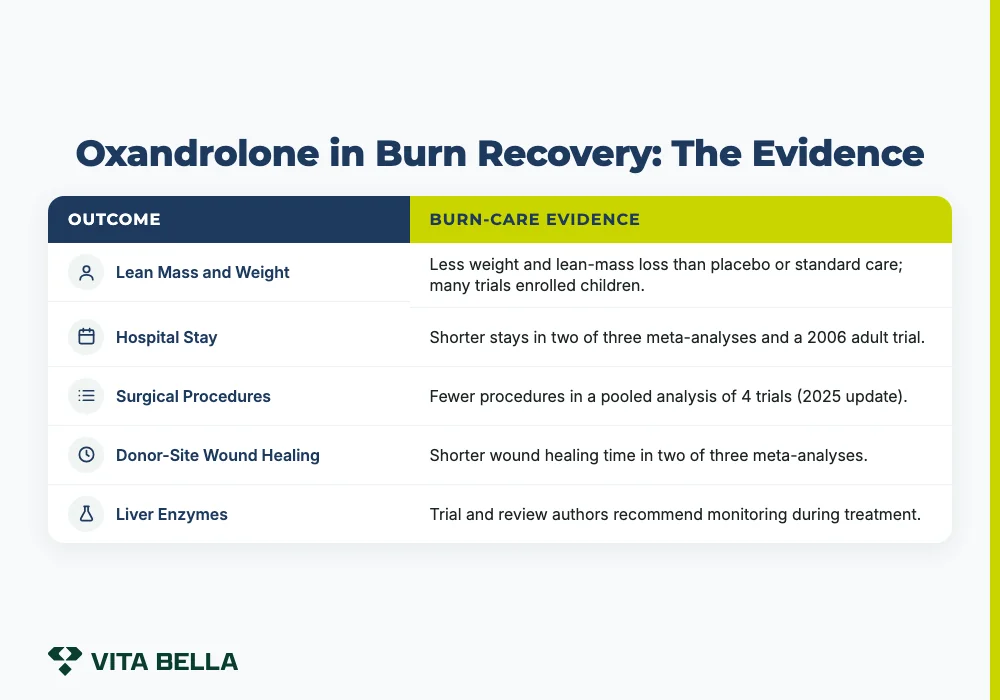
The strongest evidence comes from randomized trials in patients with severe burns, where lean mass, weight, wound outcomes, and hospital stay have been measured.
| Outcome | What the burn-care evidence shows | Source |
|---|---|---|
| Lean body mass and weight | Less loss of weight and lean mass during hospital care, and more lean mass gained at 6 and 12 months | Ring et al., 2020; Li et al., 2016 |
| Hospital stay | Shorter hospital stays in a 2006 adult trial and two meta-analyses; the 2025 update found no significant difference in total days | Wolf et al., 2006; Ring et al., 2020; Li et al., 2016; Lou et al., 2025 |
| Surgical burden | Fewer surgical procedures in a pooled analysis of 4 trials, with wide variation between trials | Lou et al., 2025 |
| Skin graft donor sites | Shorter donor-site wound healing time in two meta-analyses; the 2025 update found no significant difference | Ring et al., 2020; Li et al., 2016; Lou et al., 2025 |
Much of this evidence comes from children: 9 of the 14 trials in the 2025 update enrolled pediatric patients (Lou et al., 2025). None of the three meta-analyses found a significant difference in mortality (Ring et al., 2020; Li et al., 2016; Lou et al., 2025), and Li et al. and Lou et al. also found no significant difference in infection rates. These benefits were measured in hospitalized patients with severe burns, so a provider weighs how far they apply to other injuries.
Does oxandrolone help with wound healing?
In severe burns, the evidence is encouraging. Two meta-analyses found that skin graft donor sites recovered faster with oxandrolone: Ring et al. (2020, Journal of Burn Care & Research) and Li et al. (2016, Burns), whose pooled data showed donor-site wound healing time about four days shorter. A 2025 update by Lou et al. in the World Journal of Emergency Surgery reported fewer surgical procedures, but its donor-site result did not reach significance and it found no significant difference in total hospital days.
Outside burns, the evidence is thinner. A 2017 Cochrane review of anabolic steroids for pressure ulcers found a single randomized trial, in 212 people with spinal cord injury, which was stopped early when oxandrolone showed no benefit over placebo; the reviewers rated that evidence as very low certainty (Naing and Whittaker, 2017).
Ring et al. concluded that the evidence suggests oxandrolone is a beneficial adjunct to the acute care of burn patients, shortening hospital stays and improving several growth and wound healing parameters. Most research on Anavar wound healing comes from burn care, which makes oxandrolone burn recovery the best-documented part of its recovery evidence.
How long should you take oxandrolone for injury recovery?
At Vita Bella, oxandrolone injury recovery is short term: no longer than 8 weeks, and always paired with testosterone. Within that limit, a licensed provider sets the length of treatment after reviewing your labs, the type and stage of your injury, and how your recovery is progressing.
Liver enzymes may rise in some adults taking oxandrolone; the 2025 update highlights this in adult burn patients (Lou et al., 2025), while two other meta-analyses found no significant difference in liver dysfunction (Ring et al., 2020; Li et al., 2016). Trial and review authors recommend checking liver enzymes during treatment (Wolf et al., 2006; Ring et al., 2020), and your provider decides when to check them. When the oxandrolone phase ends, your provider decides whether and how testosterone therapy continues.
Why is testosterone added when using oxandrolone for recovery?
Like other anabolic steroids, oxandrolone may lower the body's own testosterone production: in a randomized trial in men with HIV-associated weight loss, it was associated with lower luteinizing hormone and lower total and free testosterone (Grunfeld et al., 2006). Its androgenic activity is also relatively low compared with its anabolic activity (Wu and Kovac, 2016), so on its own it may not make up for that drop.
Pairing it with testosterone through provider-managed hormone therapy is meant to keep testosterone levels supported during the oxandrolone phase. At Vita Bella, this pairing is standard: oxandrolone injury recovery always includes provider-managed testosterone, with both adjusted to your labs and recovery stage.
Monitoring during oxandrolone injury recovery
Labs come first: your provider reviews baseline results before treatment starts and decides which follow-up labs to order during and after the oxandrolone phase, based on your history and how your recovery is progressing.
Quarterly provider check-ins are built into the care model. Labs are ordered and reviewed by your provider and billed separately from the membership, and a licensed provider determines the dose after labs.
Ready to explore injury recovery support?
Oxandrolone injury recovery is a provider-led process, not a supplement protocol. If you are recovering from surgery or a significant injury and want to know whether anabolic support fits your situation, Get Started to begin the intake process with a licensed Vita Bella provider.
Frequently asked questions
In severe burns, two meta-analyses found shorter donor-site wound healing time with oxandrolone (Ring et al., 2020; Li et al., 2016), while a 2025 update found no significant difference (Lou et al., 2025). Outside burns, a randomized trial in chronic pressure ulcers did not show a benefit over placebo (Naing and Whittaker, 2017), so a provider reviews how this evidence applies to your injury.
At Vita Bella, oxandrolone is used short term, for no longer than 8 weeks, and always paired with testosterone. A licensed provider sets the exact length within that limit after reviewing your labs and the stage of your injury.
Oxandrolone may lower the body's own testosterone production (Grunfeld et al., 2006) while offering relatively little androgenic activity on its own (Wu and Kovac, 2016). At Vita Bella, provider-managed testosterone is paired with it to keep testosterone levels supported during the oxandrolone phase.
The strongest evidence comes from severe burns, where a randomized trial found shorter hospital stays (Wolf et al., 2006) and two meta-analyses found shorter stays and less loss of weight and lean mass (Ring et al., 2020; Li et al., 2016). Outside burns, small randomized trials in trauma and surgical patients did not find a benefit (Gervasio et al., 2000; Bulger et al., 2004), so a provider weighs this evidence against your injury, history, and labs.
Sources
- Lou J et al. (2025). Oxandrolone for burn patients: a systematic review and updated meta-analysis of randomized controlled trials from 2005 to 2025. World journal of emergency surgery : WJES. PubMed
- Ring J et al. (2020). Oxandrolone in the Treatment of Burn Injuries: A Systematic Review and Meta-analysis. Journal of burn care & research : official publication of the American Burn Association. PubMed
- Li H et al. (2016). The efficacy and safety of oxandrolone treatment for patients with severe burns: A systematic review and meta-analysis. Burns : journal of the International Society for Burn Injuries. PubMed
- Wolf SE et al. (2006). Effects of oxandrolone on outcome measures in the severely burned: a multicenter prospective randomized double-blind trial. Journal of burn care & research. PubMed
- Wu C, Kovac JR (2016). Novel Uses for the Anabolic Androgenic Steroids Nandrolone and Oxandrolone in the Management of Male Health. Current urology reports. PubMed
- Naing C, Whittaker MA (2017). Anabolic steroids for treating pressure ulcers. Cochrane Database of Systematic Reviews. PubMed
- Gervasio JM et al. (2000). Oxandrolone in trauma patients. Pharmacotherapy. PubMed
- Bulger EM et al. (2004). Oxandrolone does not improve outcome of ventilator dependent surgical patients. Annals of Surgery. PubMed
- Grunfeld C et al. (2006). Oxandrolone in the treatment of HIV-associated weight loss in men: a randomized, double-blind, placebo-controlled study. Journal of Acquired Immune Deficiency Syndromes. PubMed