
This TRT treatment guide covers every stage of the process: confirming low testosterone with labs, choosing a delivery method, and monitoring results over time. A complete testosterone replacement therapy program is provider-supervised and built around your lab findings, symptoms, and health history. Most men notice initial changes in energy and libido within three to six weeks; full benefits build over several months. Benefits and risks vary by delivery method, underlying cause, and individual health history, which is why each protocol is built around your specific labs.
Following a TRT treatment guide: the four stages
A structured protocol moves through four phases. Each builds on the last.
- Pre-treatment evaluation: baseline labs and a telehealth consultation confirm diagnosis and assess whether TRT is appropriate.
- Treatment selection: the provider selects a delivery method based on your lab values, comorbidities, and lifestyle preferences.
- Early response period: the first one to three months, when symptoms begin to shift and the provider fine-tunes the protocol.
- Ongoing monitoring: regular labs and quarterly check-ins ensure levels stay in a beneficial range throughout treatment.
Understanding these stages helps you set realistic expectations and engage productively with your care team.
What blood tests are needed before starting TRT?
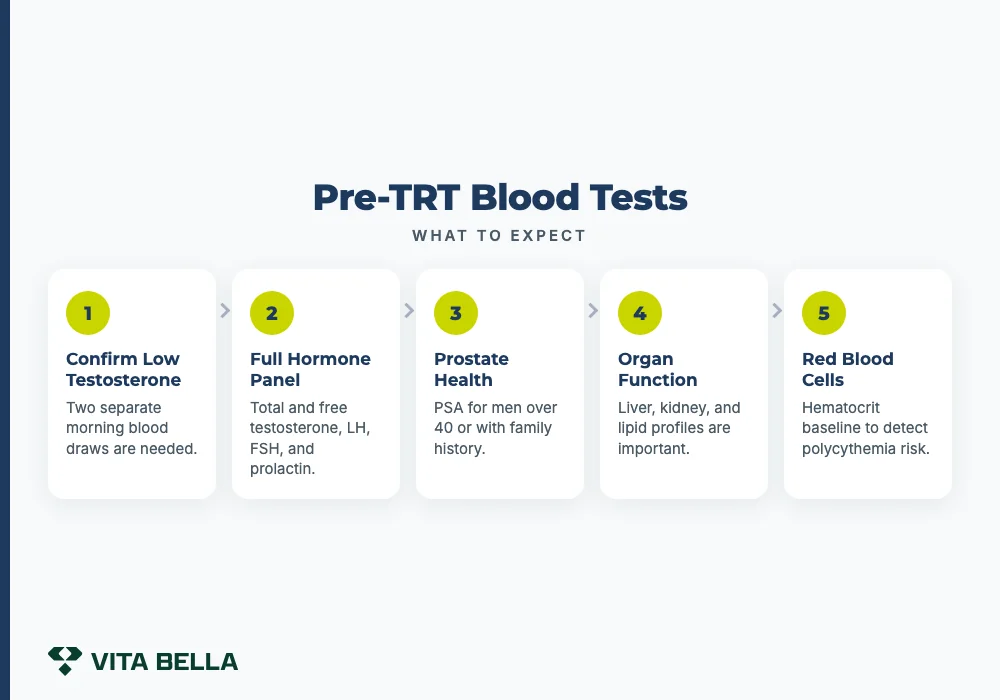
Before any prescription is written, you need at least two separate morning blood draws confirming low serum testosterone, per the Androgen Replacement guidelines in StatPearls. The morning draw matters. Testosterone peaks early in the day, so an afternoon reading can miss true deficiency.
A complete pre-TRT evaluation includes:
- Total testosterone (morning sample, repeated on a second visit to confirm the finding)
- Free testosterone: particularly relevant when total levels are borderline; understanding how free and total testosterone differ in what they reveal can clarify why total testosterone alone sometimes underrepresents the problem
- PSA (prostate-specific antigen): standard for men over 40 and for anyone with a family history of prostate cancer
- Hematocrit: a baseline measure to detect risk of polycythemia (elevated red blood cell volume) before therapy begins
- Liver and kidney function panels
- Lipid profile
- LH, FSH, and prolactin: in cases where the cause of low testosterone is unclear
The 2022 pre-TRT checklist published in the Journal of Sexual Medicine by Flores et al. also emphasizes reviewing family history of prostate and cardiovascular disease, plus current medications that may interact with therapy. Labs are ordered through Quest Diagnostics, reviewed by your provider before the consultation, and billed separately from your membership fee.
What are the different types of TRT?
Low testosterone treatment options fall into three main categories covered in every TRT treatment guide. What to expect at your TRT consultation is a focused review of your labs followed by a conversation about which delivery method fits your body, schedule, and goals.
| Delivery method | How it works | Key trade-offs |
|---|---|---|
| Testosterone cypionate injection | Administered into muscle periodically; a licensed provider determines the dose after labs | Can cause peaks and troughs in hormone levels; requires self-injection or clinic visits |
| Testosterone cream | Applied to skin daily; produces more stable levels than periodic injections | Easier self-administration; risk of transfer to others through skin contact |
| Enclomiphene (oral) | A selective estrogen receptor modulator that stimulates the body's own testosterone production by raising LH and FSH | Preserves natural testosterone production and sperm function; often preferred when fertility matters |
The difference between testosterone cypionate vs cream comes down to stability vs convenience. Research on TRT preparation pharmacology by Shoskes et al. (2016) in Translational Andrology and Urology shows that injectable forms produce wider hormonal fluctuations, while topical formulations maintain steadier daily levels at the cost of skin-to-skin transfer risk.
Enclomiphene works differently from both. Rather than replacing testosterone externally, it supports the body's internal production, which is why it is often preferred when maintaining sperm production matters. For a detailed comparison, the enclomiphene vs clomiphene page explains how both medications work and differ. Treatment choice depends on individual factors including age, comorbidities, and whether stable hormone levels or dosing convenience is the priority, as noted by Sizar et al. in StatPearls.
What happens to your body when you start TRT?
Your body responds in stages. Onset-of-effects research by Saad et al. in the European Journal of Endocrinology (2011) found that changes in mood, energy, and sexual function tend to appear before physical changes become visible. The 2009 review by Bassil et al. in Therapeutics and Clinical Risk Management notes that improvements in libido, mood, and energy are among the earliest and most consistent responses to therapy.
Expected changes in the early weeks, based on onset-of-effects research by Saad et al.:
- Libido and sexual function: improvements typically emerge within three to six weeks
- Mood and energy: many men report noticeable change within three to four weeks
- Concentration and confidence: shifts often appear around three weeks
- Fatigue reduction: may occur anywhere between one and six weeks after starting
TRT side effects in the first month are possible but uncommon at physiological doses. Effects that may occur during early treatment include acne, mild fluid retention, or mood changes. These are generally mild and reversible with provider-guided adjustments, as noted in the 2024 TestES evidence synthesis by Cruickshank et al.. The 2024 updated meta-analysis by Corona et al. in Expert Opinion on Drug Safety found that cardiovascular risk in properly monitored TRT is an area of active research, reinforcing the importance of pre-treatment cardiovascular screening.
How long does TRT take to work?
The testosterone replacement therapy timeline varies by symptom. Some effects arrive early; others take months.
A common pattern based on onset research: energy and mood begin shifting within three to four weeks, sexual function improves by weeks three to six, and body composition changes (lean mass, reduced body fat) take three to six months to become measurable. Bone density changes typically require a year or more.
This timeline is not fixed. It depends on baseline levels, delivery method, how quickly the provider can dial in the right protocol, and individual physiology. Men whose labs show severely low starting values often notice faster subjective improvement.
One important nuance in any TRT treatment guide: how long until TRT works depends partly on how you measure progress. Mood and libido are subjective and fast-moving; body composition requires objective tracking. Understanding why optimal lab interpretation matters beyond standard reference ranges helps you read ongoing results accurately throughout treatment.
How often do you need to see a doctor while on TRT?
Monitoring is not optional. It is what separates safe, effective TRT from guesswork.
TRT monitoring blood tests follow a structured schedule. The Endocrine Society Clinical Practice Guideline by Bhasin et al. (2018) recommends rechecking serum testosterone and hematocrit within the first months of therapy and then annually, alongside a review of how symptoms have responded. Additional parameters tracked at each interval:
- Hematocrit: checked at baseline, three months, six months, and annually. Elevated hematocrit is the most common lab abnormality in TRT and informs dose decisions.
- PSA: checked before therapy, at three months, and annually. A significant rise within one year prompts further evaluation.
- Lipid profile: evaluated at baseline and periodically. Diet and activity influence cholesterol more than TRT alone, but monitoring helps detect any shift.
- DRE (digital rectal exam): performed annually for men over 40 or with elevated prostate risk in clinical settings; in telehealth, PSA provides the primary data point.
At Vita Bella, quarterly provider check-ins are built into every program so your protocol stays current as your body changes. If you are starting TRT while still planning to have children, early planning matters. What testosterone therapy means for men who want to preserve fertility is covered in detail, including strategies and alternative approaches designed to maintain reproductive function.
Take the next step
Every complete TRT treatment guide ends with ongoing provider support. Vita Bella delivers provider-led TRT care with routine labs, quarterly check-ins, and protocols that adapt as your results change. Care is delivered through 80+ licensed providers across 47 states, with discreet shipping from FDA-inspected, state-licensed U.S. pharmacies.
Frequently asked questions
Not usually. The first visit focuses on symptoms, medical history, and ordering baseline labs. Treatment begins only after results confirm low testosterone and your provider determines it is appropriate for you.
Possible side effects include mild acne, minor fluid retention, and mood changes. These are uncommon at physiological doses and are typically mild and reversible with provider-guided adjustments.
Most men notice improvements in energy and mood within three to four weeks, and libido changes within three to six weeks. Body composition gains take longer, often three to six months.
Testosterone therapy can suppress natural sperm production. Men who want to preserve fertility should discuss options with their provider before starting, as there are strategies and alternative treatments designed to protect reproductive function.
Both deliver testosterone but via different routes. Injections require less frequent administration but can cause hormonal peaks and troughs. Creams are applied daily and maintain steadier levels, though they carry a risk of transfer to others through skin contact.
Sources
- Bassil N et al. (2009). The benefits and risks of testosterone replacement therapy: a review. Therapeutics and Clinical Risk Management. PubMed
- Flores JM et al. (2022). The Pre-Testosterone Therapy Checklist. The Journal of Sexual Medicine. PubMed
- Sizar O et al. (2023). Androgen Replacement. StatPearls. PubMed
- Shoskes JJ et al. (2016). Pharmacology of testosterone replacement therapy preparations. Translational Andrology and Urology. PubMed
- Saad F et al. (2011). Onset of effects of testosterone treatment and time span until maximum effects are achieved. European Journal of Endocrinology. PubMed
- Bhasin S et al. (2018). Testosterone Therapy in Men With Hypogonadism: An Endocrine Society Clinical Practice Guideline. The Journal of Clinical Endocrinology and Metabolism. PubMed
- Cruickshank M et al. (2024). The effects and safety of testosterone replacement therapy for men with hypogonadism: the TestES evidence synthesis and economic evaluation. Health Technology Assessment. PubMed
- Corona G et al. (2024). Cardiovascular safety of testosterone replacement therapy in men: an updated systematic review and meta-analysis. Expert Opinion on Drug Safety. PubMed