The best peptides with TRT combine testosterone replacement therapy with growth hormone secretagogues, targeting two complementary hormone axes at once. Testosterone drives androgen receptor signaling for protein synthesis and muscle mass, while peptides stimulate the GH/IGF-1 axis for recovery, tissue repair, and body composition. These systems reinforce each other. A licensed provider reviews your labs and goals before recommending any specific combination.
How do peptides and testosterone work together?
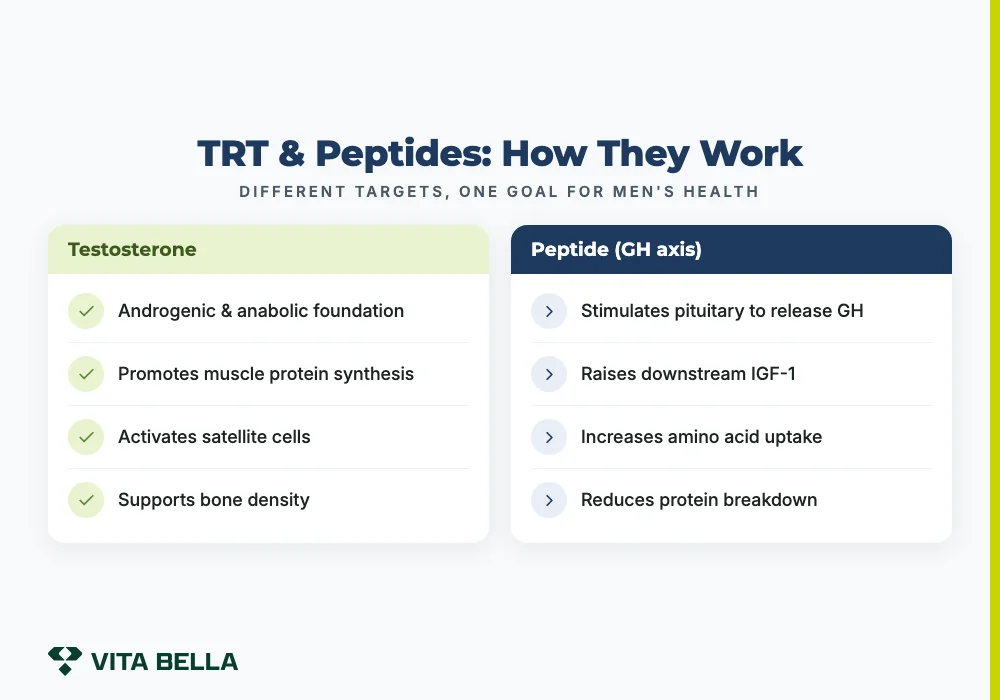
Testosterone supplies the androgenic and anabolic foundation. It promotes muscle protein synthesis, satellite cell activation, and bone density, as outlined in a 2017 review in Reviews in Urology (Tyagi et al.). Growth hormone peptides activate a separate axis. They stimulate the pituitary to release GH, which raises downstream IGF-1. Different targets, one goal.
A 2020 study in Frontiers in Physiology (Gharahdaghi et al.) confirmed that testosterone and the GH/IGF-1 axis act on overlapping but distinct intracellular pathways, producing additive gains in lean mass and muscle performance when combined. A 2008 study in Growth Hormone & IGF Research (Giannoulis et al.) found that combined GH and testosterone administration produced greater reductions in fat mass and better metabolic outcomes than either hormone alone in healthy elderly men.
The practical picture looks like this:
| Goal | Testosterone | Peptide (GH axis) |
|---|---|---|
| Muscle hypertrophy | Androgen receptor activation, satellite cell recruitment | IGF-1 stimulation, amino acid uptake, reduced protein breakdown |
| Fat metabolism | Lipolysis via androgen receptor signaling | Increased lipolysis, altered lipoprotein kinetics |
| Recovery and repair | Anabolic signaling, energy, mood support | Collagen synthesis, tissue repair, sleep architecture |
What peptides stack best with TRT?
Four configurations appear most often in clinical peptide practice: the CJC-1295 and ipamorelin combination, the sermorelin TRT combination, BPC-157 paired with testosterone, and tesamorelin for body recomposition. Each targets a different part of the hormone-recovery picture. The right choice depends on your primary goals and what labs show.
CJC-1295 ipamorelin stack
CJC-1295 (without DAC) is a GHRH analogue that amplifies individual natural GH pulses. Ipamorelin is a selective GH-releasing peptide with minimal effect on cortisol or ACTH. Together, they raise endogenous GH and downstream IGF-1 through two distinct receptor pathways. Add TRT, and the CJC-1295 ipamorelin stack covers both androgen receptor signaling and the GH/IGF-1 axis in a single protocol. Labs are recommended rather than required and help individualize the approach; a provider determines the dose based on your goals.
Sermorelin TRT combination
Sermorelin is a GHRH analogue that stimulates the pituitary to produce GH in a pulsatile, physiologic pattern. The sermorelin TRT combination suits patients whose profile calls for a shorter-acting GHRH approach. Providers select between sermorelin and CJC-1295 based on goals and individual response. A licensed provider determines the dose.
BPC-157 and testosterone
BPC-157 is a pentadecapeptide derived from gastric juice. In animal models, it promotes angiogenesis, upregulates growth factor expression, and supports tendon and ligament recovery, as reported in a 2014 study in Molecules (Chang et al.). Pairing BPC-157 and testosterone is used when musculoskeletal repair is the limiting factor. BPC-157 addresses connective tissue directly; TRT supports collagen synthesis and muscle anabolism on the same timeline. A provider determines the dose based on your goals and health history.
Tesamorelin with TRT
Tesamorelin is a GHRH analogue with a clinical indication for reducing abdominal visceral adipose tissue. A 2014 randomized trial in JAMA (Stanley et al.) demonstrated its effects on visceral and liver fat. Combined with TRT, it targets visceral fat accumulation while testosterone maintains the androgenic foundation for lean mass. Baseline IGF-1 is recommended before starting, and quarterly provider check-ins track response. Tesamorelin is part of Vita Bella's product offering; a provider determines the dose based on your clinical profile.
Best peptides with TRT for muscle growth
The growth hormone peptides men use most for building lean mass on TRT are CJC-1295 and ipamorelin. GH and IGF-1 increase amino acid uptake and reduce protein breakdown; testosterone drives androgen receptor-mediated protein synthesis. Different pathways, same objective. The Gharahdaghi 2020 review in Frontiers in Physiology describes their combined activity as additive or synergistic for lean mass outcomes.
The peptide stack muscle growth picture extends beyond GH secretagogues for many patients. BPC-157 supports connective tissue recovery, and training consistency over months is what actually produces lasting hypertrophy. A 2024 case report in Cureus (Sanders et al.) documented a roughly 6% increase in lean muscle mass during an initial TRT phase, illustrating why hormonal optimization often precedes adding peptides to the protocol.
For men managing body composition alongside TRT, how peptides protect lean mass during a caloric deficit explains why GH peptides are frequently included in weight-loss protocols.
Is it safe to combine peptides with TRT?
Yes, under licensed provider supervision. The specific compounds chosen, individual lab values, and protocol adjustments over time all affect the safety profile. GH secretagogues raise IGF-1, which providers track through optional baseline labs and quarterly check-ins. Testosterone therapy requires hormone labs before prescribing. Both systems can influence insulin sensitivity and other metabolic markers, which is another reason routine monitoring makes clinical sense.
No combination is appropriate for every patient. Provider evaluation is how the best peptides with TRT get matched to a specific person, not assumed from a general list. Which lab markers to order before starting a peptide or hormone protocol covers the key baseline and monitoring tests in detail.
What is the best peptide protocol for men on TRT?
There is no single protocol because these programs are individualized. Labs are recommended rather than required for peptide programs; they help a provider determine the dose and personalize the approach. The most common starting point for performance-focused men combines CJC-1295 and ipamorelin alongside TRT, since this covers GH/IGF-1 output and androgen signaling in parallel.
Men with active connective tissue injuries often add BPC-157 to that base. Those with prominent visceral fat accumulation may start with tesamorelin instead of, or alongside, a GH secretagogue pair. Adjustments happen through quarterly provider check-ins based on how you respond over time.
How providers build multi-cycle programs, rotate compounds, and evaluate outcomes across phases is covered in the guide to peptide program structure and safe cycling.
Start your evaluation
A provider-guided evaluation is the first step toward identifying the right peptide and testosterone stack for your goals. The intake process takes under two minutes.
Frequently asked questions
The CJC-1295 ipamorelin stack is the most widely used starting point because it raises endogenous GH and IGF-1 while TRT covers androgenic signaling. BPC-157 is commonly added when joint or tendon recovery is a priority.
Testosterone activates androgen receptors to drive protein synthesis and satellite cell recruitment, while growth hormone peptides stimulate the GH/IGF-1 axis to increase amino acid uptake and support tissue repair. A 2020 review in Frontiers in Physiology confirmed these are complementary, not redundant, pathways.
Yes, when prescribed and monitored by a licensed provider. A provider reviews labs and health history before recommending any combination, and quarterly provider check-ins allow protocol adjustments based on individual response.
There is no single answer because protocols are built around individual goals and labs. The CJC-1295 ipamorelin stack is a common starting point for muscle growth and recovery, with BPC-157 or tesamorelin added based on specific needs.
CJC-1295 and ipamorelin are the primary choices for peptide stack muscle growth because they amplify GH and IGF-1, which acts synergistically with testosterone's androgen receptor signaling to increase lean mass and reduce protein breakdown.
Sources
- Tyagi V et al. (2017). Revisiting the role of testosterone: Are we missing something? Reviews in Urology. PubMed
- Gharahdaghi N et al. (2020). Links between testosterone, oestrogen, and the growth hormone/insulin-like growth factor axis and resistance exercise muscle adaptations. Frontiers in Physiology. PubMed
- Giannoulis MG et al. (2008). The effects of growth hormone and/or testosterone administration on body composition and lipid metabolism in healthy elderly men. Growth Hormone & IGF Research. PubMed
- Chang CH et al. (2014). Pentadecapeptide BPC 157 enhances the growth hormone receptor expression in tendon fibroblasts. Molecules. PubMed
- Stanley TL et al. (2014). Effect of tesamorelin on visceral fat and liver fat in HIV-infected patients with abdominal fat accumulation: A randomized clinical trial. JAMA. PubMed
- Sanders GJ et al. (2024). Dose-response effects of exercise and testosterone replacement therapy on body composition, lean mass, and heart rate responses: A case report using wearable technology. Cureus. PubMed