Tesamorelin vs sermorelin is a question of potency and purpose. Tesamorelin, a modified GHRH analogue, produced approximately 15–18% visceral adipose tissue (VAT) reduction over 26–52 weeks in clinical trials. Sermorelin restores natural pulsatile GH release for anti-aging, recovery, and gradual fat loss. Both are growth hormone releasing peptide therapy options that stimulate the pituitary rather than supplying exogenous HGH.
| Tesamorelin | Sermorelin | |
|---|---|---|
| Mechanism | Modified GHRH analogue, enhanced stability | GHRH 1-29 fragment |
| Primary use | Visceral fat reduction | Anti-aging, GH restoration, recovery |
| Potency | Higher, more targeted | Gentler, more gradual |
| Key clinical finding | ~15–18% VAT reduction over 26–52 weeks | Restores pulsatile GH secretion |
| Side effects | Injection-site reactions, transient glucose changes | Generally mild |
| Best fit | Excess belly fat, metabolic risk | Sleep, energy, recovery, wellness |
What is the difference between tesamorelin and sermorelin?
The structural difference explains the clinical gap. Tesamorelin is a synthetic GHRH analogue modified to improve plasma stability and pharmacokinetics, producing more sustained GH release compared to native GHRH (Al Musaimi, 2024, Biomolecules). That engineering drives the potency gap.
Sermorelin is the first 29 amino acids of endogenous GHRH, a shorter fragment that gently prompts the pituitary to release GH in natural, pulsatile rhythms. Both peptides drive downstream IGF-1 increases and promote lipolysis. This is the core of the tesamorelin vs sermorelin GHRH peptide comparison: targeted metabolic intensity versus physiological restoration. Neither delivers exogenous HGH directly, so both preserve the natural feedback loops that direct HGH injections can disrupt.
Which peptide is better for fat loss?
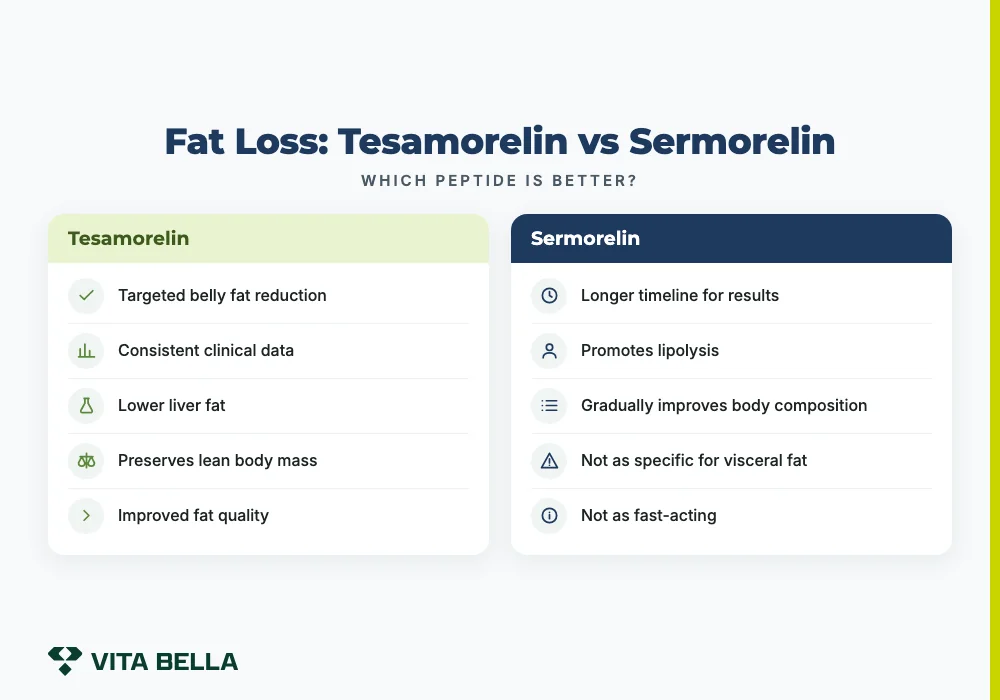
For targeted tesamorelin belly fat reduction, the clinical data is consistent. A 2020 randomized clinical trial documented approximately 15–18% VAT reduction over 26–52 weeks versus placebo (Stanley et al., 2020), alongside roughly 40% lower liver fat in treatment groups. Two 2026 meta-analyses confirmed these findings in people living with HIV with lipodystrophy:
- Ditta et al. found significant VAT reduction and improved lipid profiles across included studies (Ditta et al., 2026, PubMed).
- Badran et al. confirmed reductions in hepatic fat and metabolic markers across randomized controlled trials (Badran et al., 2026, PubMed).
- Lean body mass was preserved throughout treatment.
- Fat quality improved, with less intramuscular fat and increased fat density in truncal muscle groups (Lake et al., 2021, AIDS).
Sermorelin for fat loss is real, but the timeline is longer. Elevated GH and downstream IGF-1 promote lipolysis and gradually improve body composition. It is not as specific or fast-acting for visceral fat peptide treatment. If addressing stubborn belly fat is the primary goal, tesamorelin is the more direct tool.
Who should choose tesamorelin over sermorelin?
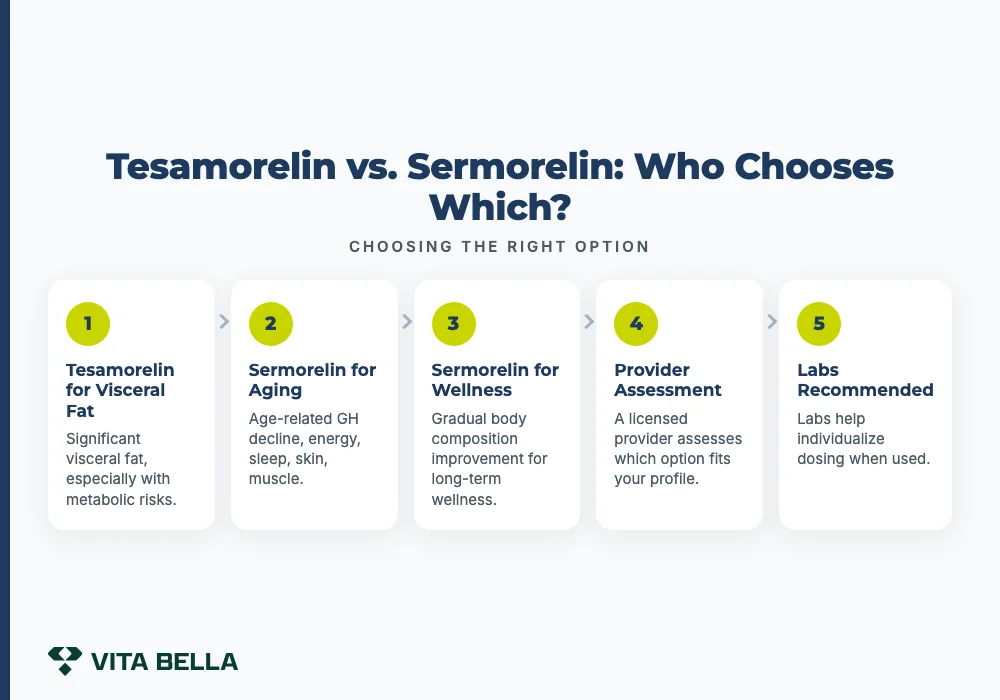
Tesamorelin fits a specific clinical profile: significant visceral fat, particularly when metabolic risk factors like elevated triglycerides or liver fat are present. The primary evidence comes from HIV-associated lipodystrophy, where truncal fat and dyslipidemia are pronounced, but the fat-reduction mechanism is not disease-specific. When that visceral fat represents an active metabolic problem, tesamorelin is the stronger choice.
Sermorelin anti-aging benefits make it a better match for a different set of concerns:
- Energy and vitality that decline with age-related GH reduction.
- Sleep quality, which GH plays a direct role in supporting during restorative cycles.
- Skin elasticity, muscle tone, and recovery that respond to elevated IGF-1 over time.
- Gradual body composition improvement for those who want long-term wellness over targeted reduction.
Walker (2006, Therapeutics and Clinical Risk Management) documented that sermorelin restores the GH secretion patterns that decline with age. A licensed provider assesses which option fits your profile; labs are recommended rather than required and help individualize dosing when used.
Can you take tesamorelin and sermorelin together?
Combining them is not standard practice. Both bind the GHRH receptor in the anterior pituitary, so simultaneous use could produce additive GH stimulation without established clinical guidance on managing that response. Running one compound for a defined period before transitioning to the other is a more common clinical approach. That decision belongs to your provider, who factors in your goals and any monitoring data. For context on how providers structure these decisions across treatment phases, see how GHRH peptide programs are structured and adjusted over time.
How long does sermorelin take to show results?
Sermorelin works on a longer clock. Sleep quality and energy improvements often appear within 4–8 weeks. Measurable shifts in body composition, skin, and recovery typically take 3–6 months of consistent use. That timeline reflects the mechanism: pulsatile GH restoration rather than a rapid pharmacological response.
Tesamorelin moves faster on visceral fat. Measurable VAT reductions are documented by 12–26 weeks in clinical trials. Provider guidance determines how long a course runs and when to reassess. For active adults incorporating peptides alongside training, peptide protocols for athletic recovery and performance outcomes covers how these compounds fit into broader wellness programs.
Tesamorelin vs sermorelin: side effects and safety
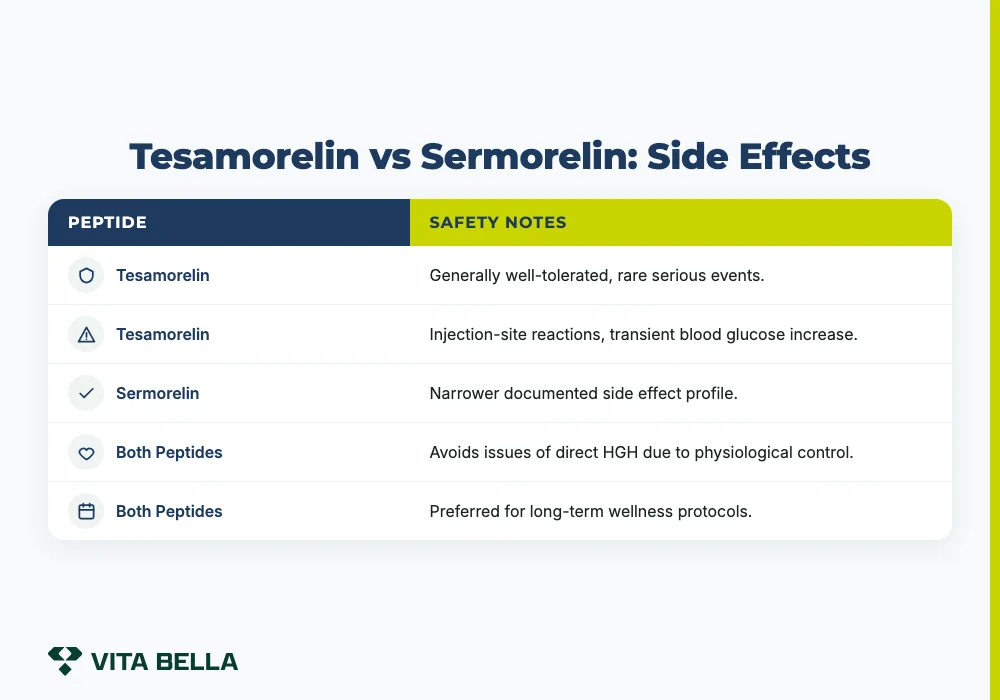
Both peptides are generally well-tolerated in clinical data. Tesamorelin side effects in trials include injection-site reactions, localized skin reactions, and early transient increases in blood glucose that resolved by 6 months (Stanley et al., 2020). Serious adverse events were rare. The 2026 meta-analyses by Ditta et al. and Badran et al. confirmed the overall safety profile across multiple randomized trials.
Sermorelin carries a narrower documented side effect profile. Because both peptides act upstream, stimulating the body's own GH release, they maintain physiological feedback control and avoid the glucose intolerance, edema, and receptor disruption associated with direct exogenous HGH. That physiological approach is why both are preferred in long-term wellness protocols.
For people combining peptide therapy with GLP-1 medications for weight loss, how peptide therapy supports body composition during caloric restriction covers the relevant overlap.
Start your peptide evaluation
The tesamorelin vs sermorelin decision is not one-size-fits-all. A licensed provider at Vita Bella walks through your goals and health history, then determines which growth hormone releasing peptide therapy approach fits your profile. Labs are recommended to help individualize your protocol; the consultation maps out next steps.
Frequently asked questions
Tesamorelin is a modified GHRH analogue engineered for targeted visceral fat reduction, with approximately 15–18% VAT reduction documented in clinical trials. Sermorelin is the 1-29 fragment of natural GHRH that restores pulsatile GH secretion for anti-aging, sleep, and recovery benefits. The two peptides serve different primary purposes and are not simply interchangeable.
Tesamorelin has a broader documented side effect profile, including injection-site reactions and early transient glucose changes that resolved during trials. Sermorelin carries a narrower risk profile given its closer alignment with natural GH secretion rhythms. Neither peptide carries the risks associated with direct exogenous HGH injections.
Someone with significant visceral fat, elevated triglycerides, or active metabolic risk factors is a stronger candidate for tesamorelin. Sermorelin is better matched to people seeking gradual anti-aging benefits, improved sleep quality, and energy restoration. A provider assessment determines which is appropriate for your specific situation.
Sources
- Ditta AM et al. (2026). Efficacy and Safety of Tesamorelin in People Living With HIV (PLWH) With Lipodystrophy: A Systematic Review and Meta-Analysis. Journal of the International Association of Providers of AIDS Care. PubMed
- Badran AS et al. (2026). Body composition, hepatic fat, metabolic, and safety outcomes of Tesamorelin, a GHRH analogue, in HIV-associated lipodystrophy: A meta-analysis of randomized controlled trials. Obesity Research & Clinical Practice. PubMed
- Stanley TL et al. (2020). Effects of a growth hormone-releasing hormone analogue on visceral fat and liver fat in HIV-infected patients with abdominal fat accumulation: A randomized clinical trial. JAMA, 312(4), 380–389. PubMed
- Al Musaimi O. (2024). Exploring FDA-Approved Frontiers: Insights into Natural and Engineered Peptide Analogues. Biomolecules, 14(3), 264. doi
- Lake JE et al. (2021). Tesamorelin improves fat quality independent of changes in fat quantity. AIDS, 35(9), 1395–1402. doi
- Walker RF. (2006). Sermorelin: A better approach to management of adult-onset growth hormone deficiency. Therapeutics and Clinical Risk Management, 2(4), 429–437. PubMed