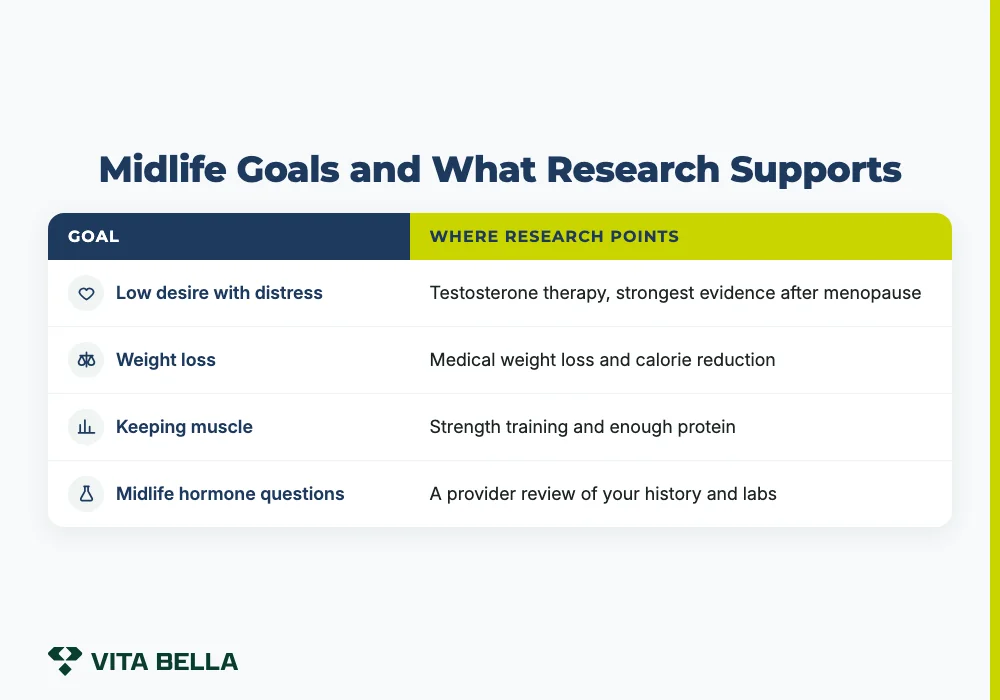
Testosterone is a normal and important hormone for women, and after menopause, testosterone therapy is backed by top-grade clinical trial evidence for low sexual desire that causes distress (Davis et al., 2019). Trials show that it improves sexual desire, arousal, and pleasure in postmenopausal women with low desire that causes distress. Weight is a separate goal with its own best-studied tools, so the best approach matches each goal with its own evidence: testosterone for low desire with distress, and a provider-led medical weight loss program for weight. Here is what the research on testosterone for women weight loss shows and how a provider puts the pieces together.
Does testosterone help women lose weight?
Testosterone therapy for women is used in sexual wellness care, specifically for low sexual desire that causes distress, which is where its research is strongest. Its clinical trials were designed around sexual function and show consistent benefits there (Islam et al., 2019; Davis, 2025), so that is testosterone's established use for women. Weight goals are best matched with options tested for weight loss.
That takes nothing away from testosterone. It simply means pairing each goal with the option that was studied for it. If you are researching testosterone for women weight loss, the useful question is what each option does well and how a provider brings them together.
What testosterone does in a woman's body
A 2025 review in Climacteric describes testosterone as a normal female hormone with important effects in many tissues (Davis, 2025). It works in more than one way. It can act directly on androgen receptors, or the body can convert it to the more potent androgen dihydrotestosterone or to estradiol (Davis et al., 2019).
Where testosterone therapy shows clear benefits: sexual health after menopause
For postmenopausal women with low desire that causes distress, the evidence is strong and consistent across trials, reviews, and clinical guidelines.
- A 2019 meta-analysis in The Lancet Diabetes & Endocrinology included 36 randomized trials with 8,480 participants. In postmenopausal women, testosterone significantly improved sexual desire, arousal, orgasm, pleasure, responsiveness, self-image, and the frequency of satisfying sexual events, and it reduced sexual concerns and distress (Islam et al., 2019). The authors concluded that testosterone is effective for postmenopausal women with low sexual desire causing distress.
- A 2026 systematic review of 33 studies in The Journal of Sexual Medicine found testosterone therapy effective for improving key aspects of sexual function. The strongest evidence was in postmenopausal women, where randomized trials show robust benefit, and the authors called early evidence in premenopausal women promising (Furlan et al., 2026).
- Clinical guidelines support its use. The Global Consensus Position Statement, endorsed by The Endocrine Society, The North American Menopause Society, and other professional societies, supports testosterone therapy for postmenopausal women with hypoactive sexual desire disorder (HSDD), meaning low sexual desire that causes distress. It found data supporting a moderate therapeutic effect (Davis et al., 2019).
- Practical guidance for clinicians. The International Society for the Study of Women's Sexual Health (ISSWSH) guideline recommends transdermal testosterone for women with HSDD after a full biopsychosocial assessment (Parish et al., 2021). In 2025, a review in Obstetrics & Gynecology summarized these guidelines for clinicians treating perimenopausal and postmenopausal women with HSDD (Kling, 2025).
Transdermal forms, applied to the skin as a patch or cream, are preferred because they have a neutral effect on blood lipids, and no serious adverse events were recorded across the trials in the 2019 meta-analysis (Islam et al., 2019).
Why does weight change around menopause?
Midlife weight change is real, and research helps explain it. The SWAN study followed women through the menopause transition with body-composition scans. At the start of the transition, the rate of fat gain doubled while lean mass began to decline, and both shifts continued until about two years after the final period (Greendale et al., 2019).
Weight itself climbed steadily before menopause and did not speed up at the transition. So body composition can shift toward more fat and less lean mass even when the pace of weight gain on the scale does not change. Many searches for low testosterone weight gain women start from exactly these changes, which the SWAN researchers linked to the menopause transition itself (Greendale et al., 2019).
A provider looks at the full picture, including sleep, stress, activity, medications, and labs, because more than one factor is usually involved. Falling estrogen is part of that picture too. The guide to hormone replacement therapy and weight loss covers what research shows about estrogen-based HRT and weight.
What has evidence for weight loss in women?
The best place to start is with approaches that were tested for weight loss itself.
Medical weight loss under a provider
Prescription weight-loss medications such as semaglutide and tirzepatide have been tested in large randomized trials with weight loss as the main outcome (Wilding et al., 2021; Jastreboff et al., 2022). The tirzepatide guide for beginners walks through what those trials found and what the first months typically look like.
A licensed provider reviews your health history before recommending any option.
Calorie reduction, including intermittent fasting
Calorie reduction remains the foundation. A 2020 systematic review in Canadian Family Physician examined 27 intermittent fasting trials in adults with overweight or obesity (Welton et al., 2020). All of them found weight loss, ranging from 0.8% to 13.0% of baseline weight, with no serious adverse events.
In the 12 studies that compared intermittent fasting with standard calorie restriction, the results were equivalent. The trials were small and short, so the authors called the approach promising rather than proven.
Strength training and protein
Because the menopause transition shifts the balance from lean mass toward fat mass (Greendale et al., 2019), keeping muscle is a smart goal. The guide to protecting lean mass on a GLP-1 protocol covers the evidence on strength training and protein intake in detail.
How testosterone fits into a midlife health plan
Testosterone and weight care each have their own role. A provider can look at sexual wellness, weight, and other midlife changes together, then match each concern with the option that has evidence for it. For many women, that means a weight plan for the scale and, when low desire with distress is part of the picture, a conversation about testosterone.
The overview of testosterone therapy for women explains what an evaluation covers.
Can testosterone cream help with weight loss?
Questions about testosterone cream for women weight loss come up often. Transdermal testosterone, the kind applied to the skin, was used in the large randomized trials in postmenopausal women with HSDD, including one with more than 800 participants (Furlan et al., 2026). Its strength is desire and satisfaction. For weight goals, the right match is a weight-focused option, such as medical weight loss with a provider.
The guide to testosterone cream for women explains how it works and what the guidance says.
How providers monitor testosterone therapy for women
When testosterone is prescribed for low desire that causes distress (HSDD), guidelines describe a clear routine that keeps levels within the normal female range (Davis et al., 2019; Parish et al., 2021).
- Before starting: a baseline total testosterone level is measured.
- 3 to 6 weeks after starting: a repeat level checks that testosterone sits within the normal premenopausal range, so treatment can be adjusted if needed.
- Ongoing: your provider reviews how you are responding, with a total testosterone level about every 6 months.
The consensus adds a reassuring metabolic finding: in clinical trials of postmenopausal women using doses that keep testosterone in the female range, therapy was not associated with increases in blood pressure, blood glucose, or HbA1c (Davis et al., 2019).
What labs can tell you about weight and hormones
Labs give you and your provider a clear starting point. Testosterone is measured before and during treatment to keep levels in the female range (Davis et al., 2019). For weight goals, a provider usually looks at a broader panel, which can include thyroid function, glucose and other metabolic markers, and lipids.
The explainer on how SHBG shapes a testosterone result and the guide to how lab reference ranges are built show how results are read alongside symptoms.
The bottom line on testosterone and weight loss in women
The research on testosterone for women weight loss leads to a clear, positive plan. Testosterone is a valuable hormone for women, and its established therapeutic role is in sexual wellness. Trials, reviews, and guidelines consistently show better desire, arousal, and pleasure for postmenopausal women with low desire that causes distress. For weight, the best-supported tools are medical weight loss and sustainable calorie reduction, with strength training to protect muscle.
If you searched for the best testosterone for women weight loss approach, the research points to matching each goal with its own evidence: weight-focused options for weight, and testosterone for low sexual desire that causes distress, with a licensed provider evaluating which options fit you. For the male side of this topic, the men's guide to testosterone and weight loss covers a different evidence base.
Talk to a provider about weight and hormones
If testosterone for women weight loss is what brought you here, or midlife weight or desire changes are on your mind, the next step is an evaluation with a licensed provider who reviews your history and labs and explains which options fit your goals.
A licensed provider can also evaluate which hormone options fit you.
Frequently asked questions
Testosterone therapy for women is used for low sexual desire that causes distress rather than for weight loss. Its trials show consistent improvements in sexual desire, arousal, and pleasure for postmenopausal women with low desire that causes distress (Islam et al., 2019; Davis, 2025). For weight goals, options tested for weight loss, such as provider-led medical weight loss, are the place to start.
The benefits shown in clinical trials are in sexual wellness. A meta-analysis of 36 trials found improvements in desire, arousal, orgasm, pleasure, and the frequency of satisfying sexual events in postmenopausal women (Islam et al., 2019). A 2026 systematic review of 33 studies found the strongest evidence in postmenopausal women, where randomized trials show robust benefit (Furlan et al., 2026).
Testosterone cream is used for sexual wellness, specifically low desire that causes distress, which is where testosterone's evidence lies (Davis et al., 2019; Furlan et al., 2026). For testosterone cream for women weight loss questions, the better match is a weight-focused option, such as medical weight loss with a provider.
The best starting points are approaches tested for weight loss, such as medical weight loss with a provider and calorie reduction including intermittent fasting, plus strength training to protect muscle. In trials of adults with overweight or obesity, intermittent fasting led to weight loss of 0.8% to 13.0% of baseline weight, similar to standard calorie restriction (Welton et al., 2020).
Guidelines recommend a baseline total testosterone level before starting and a repeat level 3 to 6 weeks later, then regular reviews, so levels stay within the normal premenopausal range (Davis et al., 2019; Parish et al., 2021). In the trials included in the 2019 meta-analysis, no serious adverse events were recorded (Islam et al., 2019).
Sources
- Islam RM, Bell RJ, Green S, Page MJ, Davis SR. (2019). Safety and efficacy of testosterone for women: a systematic review and meta-analysis of randomised controlled trial data. Lancet Diabetes & Endocrinology. PubMed
- Furlan VA, Hammad MAM, Quesada S, Nguyen S, Yih J. (2026). Testosterone therapy for female sexual dysfunction: a systematic review of the literature demonstrating outcomes in premenopausal and postmenopausal women. Journal of Sexual Medicine. PubMed
- Davis SR et al. (2019). Global Consensus Position Statement on the Use of Testosterone Therapy for Women. Journal of Clinical Endocrinology and Metabolism. PubMed
- Parish SJ, Simon JA, Davis SR, et al. (2021). International Society for the Study of Women's Sexual Health Clinical Practice Guideline for the Use of Systemic Testosterone for Hypoactive Sexual Desire Disorder in Women. Journal of Sexual Medicine. PubMed
- Kling JM. (2025). Testosterone for the Treatment of Hypoactive Sexual Desire Disorder in Perimenopausal and Postmenopausal Women. Obstetrics and Gynecology. PubMed
- Davis SR. (2025). Not just sex: other roles for testosterone in women. Climacteric. PubMed
- Greendale GA, Sternfeld B, Huang M, et al. (2019). Changes in body composition and weight during the menopause transition. JCI Insight. PubMed
- Welton S et al. (2020). Intermittent fasting and weight loss: systematic review. Canadian Family Physician. PubMed
- Wilding JPH et al. (2021). Once-Weekly Semaglutide in Adults with Overweight or Obesity. New England Journal of Medicine. PubMed
- Jastreboff AM et al. (2022). Tirzepatide Once Weekly for the Treatment of Obesity. New England Journal of Medicine. PubMed