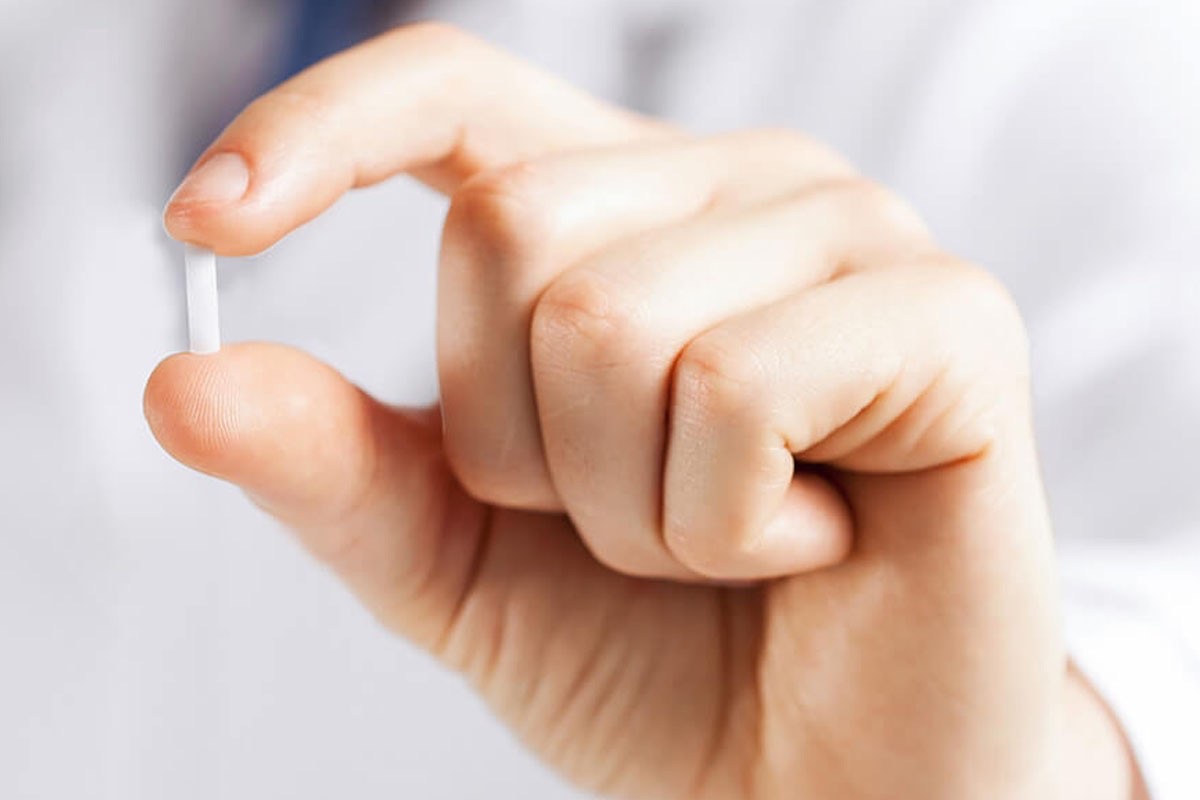
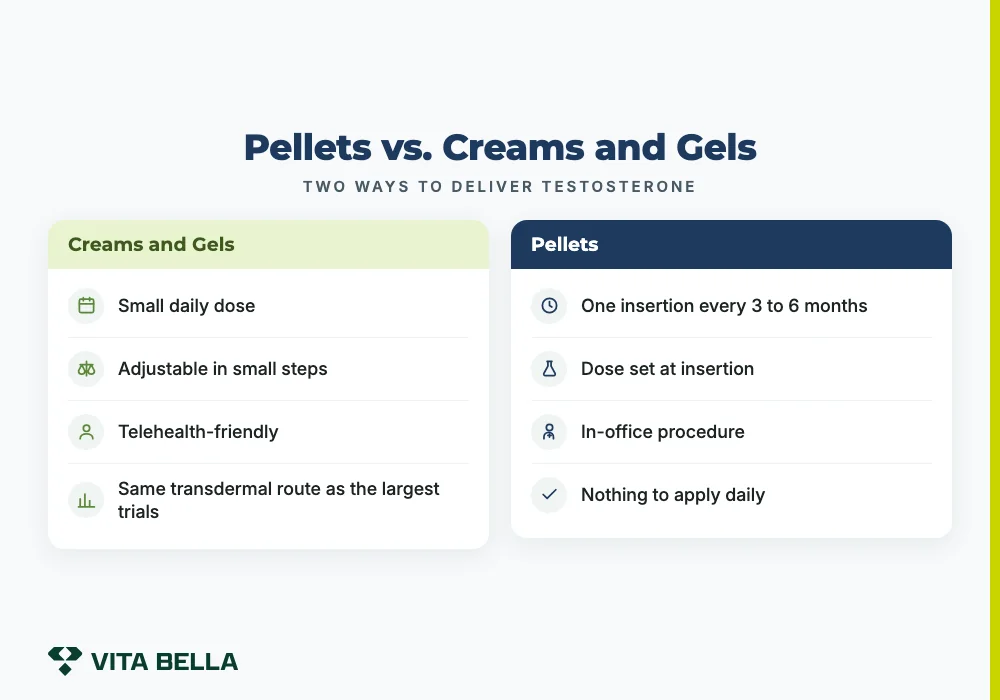
Testosterone pellets for women are small implants placed just under the skin during a brief office visit. They release testosterone gradually over roughly three to six months, so there is nothing to apply day to day. Creams and gels offer a different strength: a small daily dose that can be fine-tuned, in line with the transdermal route used in the largest trials in postmenopausal women. Pellets need an in-person procedure, so women who prefer telehealth can start with a licensed provider through Vita Bella's hormone therapy care, who reviews labs and history and explains which options fit.
What are testosterone pellets, and how do they work?
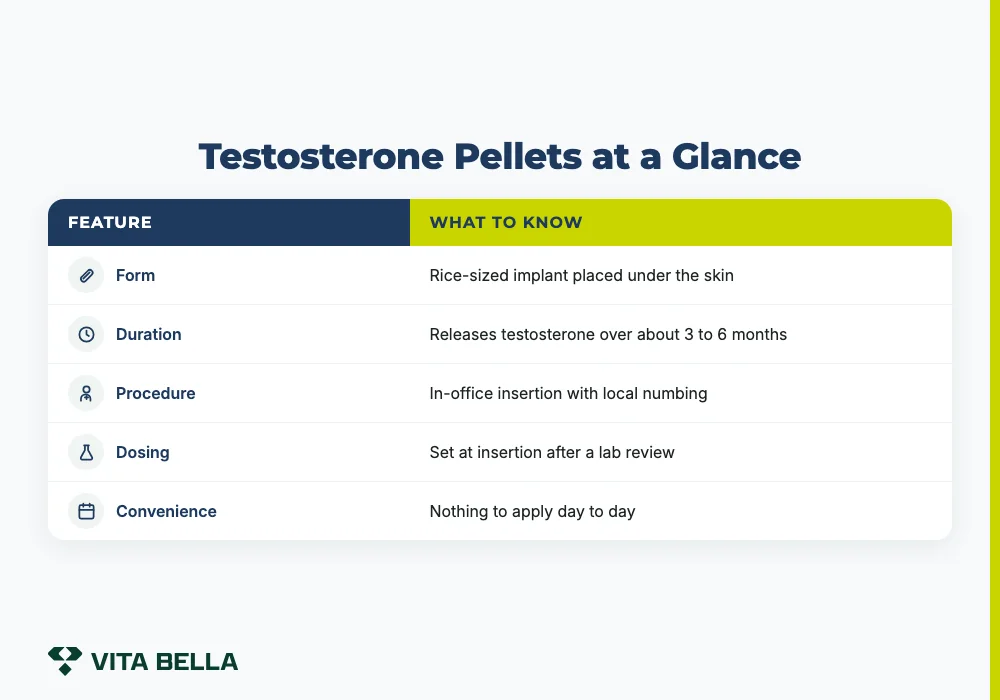
A testosterone pellet is roughly the size of a grain of rice. It is placed just under the skin, typically near the hip or buttock, in a brief in-office procedure.
The insertion procedure typically involves:
- Local numbing of the skin at the insertion site
- A small incision, typically less than a centimeter
- Placement of the pellet just beneath the skin
- Closure of the site with a bandage or small wound-closure strip
- A few days of going easy on strenuous activity while the site settles
Once in place, the pellet dissolves gradually and releases testosterone over three to six months. The release rate varies with individual metabolism and activity. Because the dose is set at insertion, a licensed provider chooses it carefully after reviewing labs.
Pellet implants require an in-office visit. Vita Bella Health does not offer pellet implants; the comparison below explains how pellets differ from other options.
Benefits of testosterone pellets for women
The benefits of testosterone pellets for women are about convenience: one insertion covers several months, and there is nothing to apply or remember each day. Many women weigh that convenience against the flexibility of a daily option that can be adjusted in small steps.
What does testosterone do for women?
Testosterone is a normal female hormone. A 2025 review in Climacteric describes it as a hormone with important effects in many tissues (Davis, 2025), and testosterone therapy has strong research behind it for low sexual desire with distress after menopause.
- Meta-analysis, 2019: 36 randomized trials with 8,480 participants. In postmenopausal women, testosterone significantly improved sexual desire, arousal, orgasm, pleasure, responsiveness, self-image, and the frequency of satisfying sexual events, and reduced sexual concerns and distress (Islam et al., 2019).
- Systematic review, 2026: across 33 studies, testosterone therapy was effective for key aspects of sexual function, with the strongest evidence in postmenopausal women, where randomized trials show robust benefit (Furlan et al., 2026).
- Guidelines: the Global Consensus Position Statement, endorsed by The Endocrine Society, The North American Menopause Society, and other professional societies, supports testosterone therapy for postmenopausal women with hypoactive sexual desire disorder (HSDD), meaning low sexual desire that causes distress (Davis et al., 2019). The ISSWSH guideline recommends transdermal testosterone for women with HSDD after a full biopsychosocial assessment (Parish et al., 2021).
This evidence comes from testosterone dosed to approximate normal premenopausal levels (Davis et al., 2019), and the largest trials, in postmenopausal women and including one with more than 800 participants, used transdermal testosterone (Furlan et al., 2026).
Perimenopause vs. post-menopause: does timing matter?
The strongest evidence is in postmenopausal women. For women before menopause, early evidence is promising (Furlan et al., 2026). A licensed provider weighs your stage alongside bloodwork and history, so hormonal stage alone does not decide the plan.
How long do testosterone pellets last?
Pellets typically last three to six months, depending on the dose and individual metabolism. A provider reviews symptoms and labs before any repeat insertion rather than following a fixed calendar.
With daily transdermal testosterone, benefits typically build over 4 to 12 weeks (Parish et al., 2021), so providers review progress over months rather than days.
Testosterone pellets vs. creams, gels, and injections
Testosterone for women comes in several forms, and each has its own rhythm.
| Method | How often | Dose adjustable? | In-office visit? |
|---|---|---|---|
| Pellets | Every 3 to 6 months | Set at insertion | Yes, for the implant |
| Injections | At set intervals | Between doses | No |
| Creams and gels | Daily | Yes, in small steps | No, telehealth-friendly |
The ISSWSH guideline favors transdermal forms, such as creams and gels, because small daily doses can keep levels within the normal premenopausal female range (Parish et al., 2021). Compared with oral testosterone, transdermal forms such as a patch or cream have a neutral effect on cholesterol (Islam et al., 2019).
A testosterone gel for women works much like a cream: it is applied to the skin each day and dosed to stay within the female range. A testosterone patch for women delivers the hormone through the skin as well. Testosterone injections for women deliver a larger dose at set intervals, so levels rise and fall between doses.
Microdosing testosterone for women usually describes small daily doses of a gel or cream kept within the normal premenopausal female range. For a closer look at how topical testosterone is applied and monitored day to day, see the guide on testosterone cream for women. Broader context is covered in women's testosterone therapy options, and how hormone delivery methods differ explains each format in more depth.
What labs do women need before starting testosterone therapy?
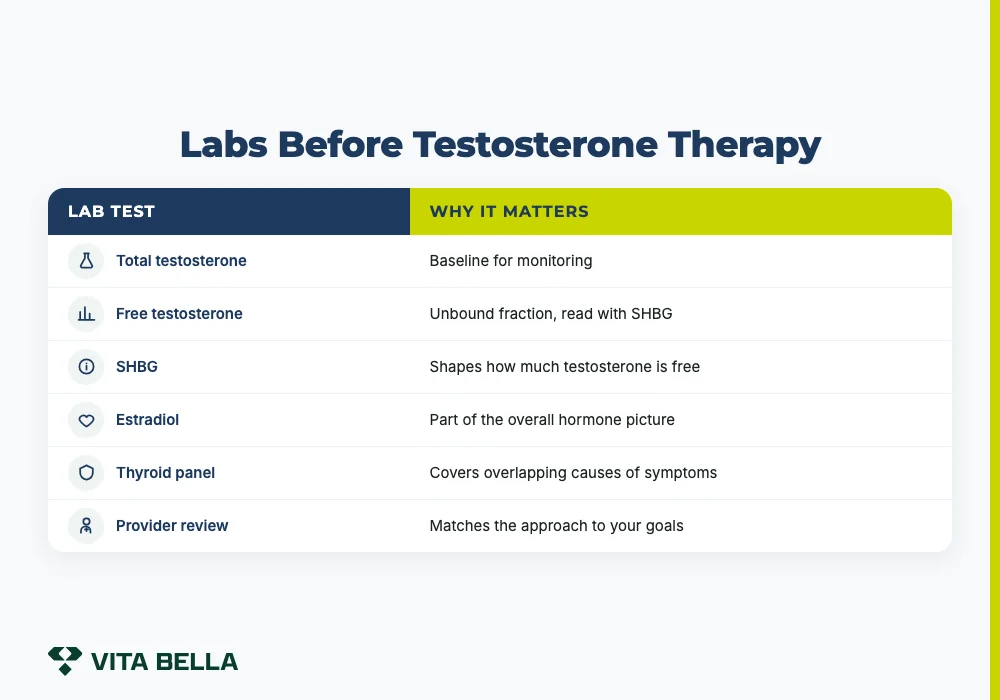
A baseline picture of your hormone levels lets a provider individualize any delivery method. For testosterone therapy, labs are ordered through Quest Diagnostics before the initial consultation and reviewed by the provider.
Labs commonly reviewed before testosterone therapy in women include:
- Total testosterone
- Free testosterone
- Sex hormone-binding globulin (SHBG)
- Estradiol
- Thyroid panel
- Complete blood count (CBC)
- Metabolic panel
A licensed provider determines which panels apply based on your symptoms and health history. Testosterone is measured before treatment as a baseline and during treatment to keep levels within the normal premenopausal female range (Davis et al., 2019).
SHBG adds useful context. It binds testosterone in the blood, so providers read it alongside total testosterone when interpreting results (Parish et al., 2021). See how SHBG shapes a testosterone result for a plain explanation of how free testosterone is read in practice. How providers read results alongside symptoms is covered in When "Normal" Labs Still Leave You Feeling Suboptimal.
A provider reviews the full panel alongside your symptom history to find the approach that fits your goals. This is what individualized care at Vita Bella looks like in practice.
What to look for in a testosterone therapy provider
A thorough provider starts with baseline labs, explains what the research shows for your goals, and revisits labs throughout treatment. Dose decisions follow data, not calendar dates.
With testosterone pellets for women, the dose is set at insertion, so a lab review before each insertion matters.
Questions worth asking any testosterone therapy provider:
- What does the research show for my goals?
- How do you choose the starting dose?
- How often do you recheck labs after the protocol begins?
- How is the dose adjusted, and how quickly?
- Is telehealth available for follow-up visits?
At Vita Bella, you pick your provider from a network of licensed practitioners, and care happens through telehealth with 1:1 provider visits, so there is no in-office procedure.
Talk to a licensed provider about your options
If you are weighing pellets against other options, the first step is an evaluation with a licensed provider who reviews your symptoms, history, and labs and explains which approach fits your goals.
Learn more about how Vita Bella's hormone therapy care works, from the first consultation through follow-up.
Frequently asked questions
Testosterone pellets for women are implanted under the skin and release testosterone gradually over roughly three to six months. The well-studied benefits of testosterone for women, better desire, arousal, and pleasure after menopause, come from testosterone dosed to the normal premenopausal female range, and the largest trials used transdermal testosterone (Islam et al., 2019; Davis et al., 2019; Furlan et al., 2026).
Pellets typically last three to six months, depending on the dose and individual metabolism. A repeat insertion follows a lab review and symptom check rather than a fixed calendar.
Through telehealth, a licensed provider can review your labs and history and evaluate which options fit. Pellets are the one delivery method that needs an in-person procedure.
Pellets release testosterone for months from a single insertion, with the dose set at that visit. Cream is applied daily, can be adjusted in small steps, and uses the same transdermal route as the largest trials in postmenopausal women (Furlan et al., 2026).
Yes. Transdermal testosterone, as a cream, gel, or patch, uses the same route as the largest trials in postmenopausal women (Furlan et al., 2026), and it can be dosed to stay within the normal premenopausal female range (Davis et al., 2019).
Sources
- Davis SR et al. (2019). Global Consensus Position Statement on the Use of Testosterone Therapy for Women. Journal of Clinical Endocrinology and Metabolism. PubMed
- Islam RM, Bell RJ, Green S, Page MJ, Davis SR. (2019). Safety and efficacy of testosterone for women: a systematic review and meta-analysis of randomised controlled trial data. Lancet Diabetes & Endocrinology. PubMed
- Furlan VA, Hammad MAM, Quesada S, Nguyen S, Yih J. (2026). Testosterone therapy for female sexual dysfunction: a systematic review of the literature demonstrating outcomes in premenopausal and postmenopausal women. Journal of Sexual Medicine. PubMed
- Parish SJ, Simon JA, Davis SR, et al. (2021). International Society for the Study of Women's Sexual Health Clinical Practice Guideline for the Use of Systemic Testosterone for Hypoactive Sexual Desire Disorder in Women. Journal of Sexual Medicine. PubMed
- Davis SR. (2025). Not just sex: other roles for testosterone in women. Climacteric. PubMed