TRT energy and libido gains are among the most documented outcomes when testosterone replacement therapy corrects a confirmed deficiency. For men with hypogonadism, clinical evidence shows improvements in sexual desire, energy, and mood within weeks to months of starting therapy. Benefits are strongest in men who begin with genuinely low testosterone; they are modest to absent in men whose levels fall within the normal range.
Low testosterone affects far more than sexual health. It disrupts protein synthesis, red blood cell production, metabolic regulation, and mood. TRT addresses these by restoring the hormone they all depend on.
What low testosterone symptoms in men look like
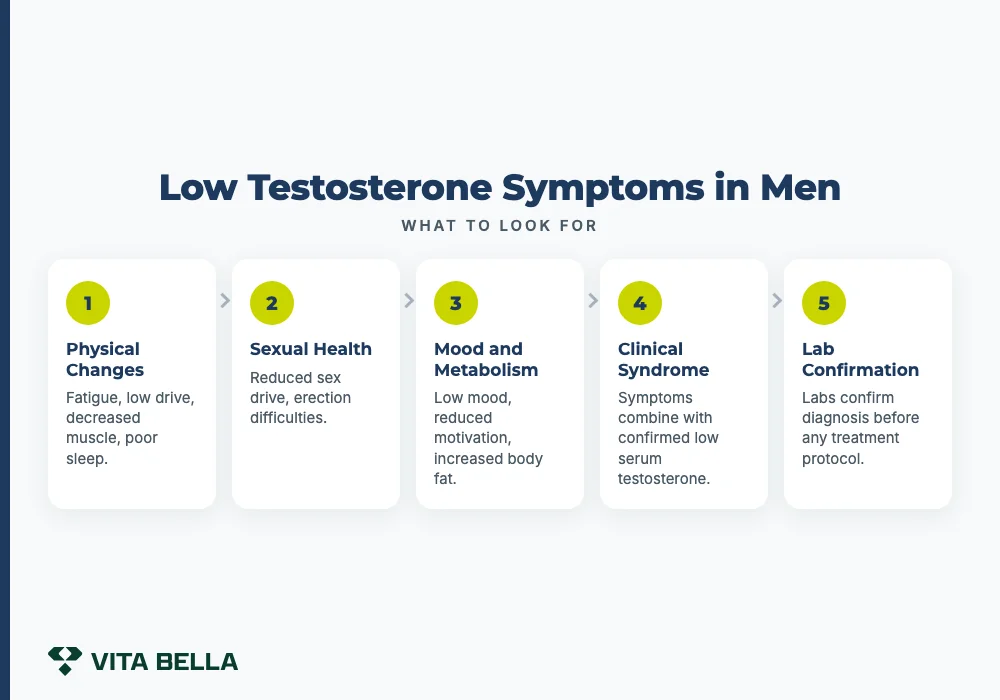
Before exploring what TRT can do, understanding deficiency helps set realistic expectations. The 2025 EAU Guidelines on male hypogonadism, published in European Urology (Salonia et al., 2025), define hypogonadism as a clinical syndrome that combines symptoms with confirmed low serum testosterone. Symptoms alone are not diagnostic; labs confirm the picture.
| Symptom | Category |
|---|---|
| Persistent fatigue and low drive | Physical / Energy |
| Reduced sex drive | Sexual |
| Difficulty achieving or maintaining erection | Sexual |
| Decreased muscle mass | Physical |
| Increased body fat | Metabolic |
| Low mood and reduced motivation | Psychological |
| Poor sleep quality | Physical |
Labs come first. A provider reviews testosterone at Quest Diagnostics alongside a clinical history before any protocol begins. Understanding how total and free testosterone interact to shape your hormone picture is an important step, since total testosterone alone can miss meaningful deficiencies.
Does TRT increase energy levels?
Yes. Testosterone therapy fatigue relief is often the first improvement men notice, sometimes within the first few weeks. A 2025 systematic review in Cureus (Rojas-Zambrano et al., 2025) found that men on TRT reported improved energy and overall quality of life compared to their pre-treatment baseline. The mechanism is direct: testosterone supports red blood cell production, which improves oxygen delivery to muscles and tissues, reducing that chronic drag.
TRT energy and libido changes tend to emerge on different timelines. Energy often responds sooner. Libido and sexual function take longer to stabilize. Tracking both with quarterly provider check-ins helps calibrate the protocol over time.
How long does TRT take to improve libido?
Most men with confirmed hypogonadism notice changes in sexual desire within three to six weeks, with more consistent gains over three to six months. A 2017 review in Current Opinion in Urology (Rizk et al., 2017) found that testosterone therapy reliably improved libido and erectile function in hypogonadal men. Erectile function may lag libido by several weeks, since vascular and neurological factors are also involved.
TRT results timeline varies by baseline level, delivery method, and individual physiology. Men who start with the lowest testosterone typically see the most noticeable TRT energy and libido changes. A licensed provider determines the dose after reviewing labs; the protocol is adjusted based on follow-up bloodwork and symptom response.
Can TRT help with muscle loss and body composition?
TRT muscle mass gains are well documented. A 2009 review in Therapeutics and Clinical Risk Management (Bassil et al., 2009) summarized that TRT in hypogonadal men improved lean body mass and reduced fat mass. The 2017 review by Rizk et al. reinforced these findings, noting consistent improvements in body composition across controlled studies. Gains are real, though most pronounced in men who start with a low baseline.
Combining TRT with resistance training and adequate dietary protein amplifies the anabolic effect. A 2023 paper in Nutrition and Health (Whittaker, 2023) found that high-protein diets support testosterone-related anabolic signaling.
For testosterone therapy for men over 40, body composition changes carry particular practical weight. After 40, muscle loss accelerates when testosterone declines. Restoring levels makes resistance training more effective and helps men hold on to what they build.
Who is a good candidate for testosterone replacement therapy?
The ideal candidate has symptoms consistent with low testosterone alongside lab-confirmed hypogonadism on at least two separate measurements. The 2025 EAU Guidelines (Salonia et al., 2025) define the criteria clearly: symptoms plus biochemical confirmation. TRT is not indicated for men whose testosterone falls within the normal range, even if they feel suboptimal.
Men who see the most consistent testosterone replacement therapy benefits typically show:
- Fatigue, low libido, or reduced muscle mass without another explanation
- Low serum testosterone on repeated testing
- No contraindications such as untreated prostate cancer or severe polycythemia
Men thinking about future family planning should discuss this before starting. TRT suppresses the body's own testosterone production and reduces sperm count. Reviewing fertility considerations before and during TRT can help men make an informed decision about timing and alternatives.
Hypogonadism treatment options extend beyond injections. For men who want to stimulate their own production rather than replace it, clomiphene-based options like enclomiphene are worth discussing with a provider. A 2022 systematic review in Andrology (Huijben et al., 2022) found that clomiphene citrate raised testosterone in hypogonadal men while preserving sperm production, making it a relevant option for men who want to maintain fertility.
What are the risks of testosterone replacement therapy?
TRT is safe under proper medical supervision, but ongoing monitoring is essential. Possible side effects, uncommon at physiological doses, may include elevated red blood cell count, mild acne, or fluid retention. These effects are generally mild and reversible with provider-guided adjustments.
A 2019 paper in the Journal of Clinical Medicine (Moon & Park, 2019) noted that long-term cardiovascular data remain limited, underscoring the need for continued monitoring. A 2025 systematic review in Hormones (Theodorakis et al., 2025) examined TRT in men with heart failure and found that careful clinical oversight kept risks manageable for appropriate candidates.
The monitoring protocol at a provider-led clinic typically tracks testosterone levels, hematocrit, PSA and, if in-clinic care is available, a digital rectal exam, as well as lipid profile and liver function. A licensed provider determines the dose after reviewing baseline and follow-up labs.
Lifestyle habits that amplify TRT energy and libido results
TRT creates a hormonal environment for change. Lifestyle determines how much of that potential you capture.
Resistance training is the most studied amplifier of TRT muscle mass gains. Regular sessions increase androgen receptor density in muscle tissue, making each unit of testosterone more effective. Sleep matters. Adequate rest reduces cortisol, which competes with testosterone at the receptor level.
Good nutrition compounds the effect. Healthy fats are precursors for steroid hormone synthesis, and sufficient protein supports lean mass retention. Excess alcohol suppresses the hypothalamic-pituitary-gonadal axis, reducing the signal that drives natural testosterone production. Stress management supports hormonal balance by limiting cortisol spikes. Combined, these habits are part of what makes TRT energy and libido improvements sustainable over the long term.
Take the first step toward better energy and drive
TRT energy and libido restoration begins with understanding your hormone levels. Answer a few questions about your symptoms and goals, and a Vita Bella licensed provider will review your intake and guide the next step.
Frequently asked questions
TRT benefits are most consistent in men with lab-confirmed hypogonadism. Men with low energy from other causes, such as sleep apnea, thyroid dysfunction, or anemia, may not respond to TRT alone. A provider-led evaluation, including labs, identifies whether testosterone deficiency is the primary driver.
Most men with hypogonadism notice changes in sexual desire within three to six weeks, with more stable gains over three to six months. Erectile function may take longer, since vascular and neurological factors also contribute. A licensed provider tracks progress at quarterly check-ins and adjusts the protocol as needed.
Possible side effects, uncommon at physiological doses, may include elevated red blood cell count, mild acne, or fluid retention. Long-term cardiovascular data are still accumulating, which is why ongoing monitoring matters. A provider-guided protocol with regular labs keeps risk low for most men who qualify.
Yes. Testosterone therapy for men over 40 is the most common use case, since testosterone levels decline with age after the mid-30s. The key qualifier is confirmed hypogonadism, not age alone. A provider reviews labs and symptoms to determine eligibility, and the protocol is adjusted as the body responds.
Sources
- Bassil N et al. (2009). The benefits and risks of testosterone replacement therapy: a review. Therapeutics and Clinical Risk Management. PubMed
- Rojas-Zambrano JG et al. (2025). Benefits of testosterone hormone in the human body: a systematic review. Cureus. PubMed
- Rizk PJ et al. (2017). Testosterone therapy improves erectile function and libido in hypogonadal men. Current Opinion in Urology. PubMed
- Moon DG & Park HJ (2019). The ideal goal of testosterone replacement therapy: maintaining testosterone levels or managing symptoms? Journal of Clinical Medicine. PubMed
- Salonia A et al. (2025). European Association of Urology Guidelines on Male Sexual and Reproductive Health: 2025 Update on Male Hypogonadism, Erectile Dysfunction, Premature Ejaculation, and Peyronie's Disease. European Urology. PubMed
- Huijben M et al. (2022). Clomiphene citrate for men with hypogonadism: a systematic review and meta-analysis. Andrology. PubMed
- Theodorakis N et al. (2025). Testosterone replacement therapy in heart failure: a systematic review of randomized controlled trials. Hormones (Athens, Greece). PubMed
- Whittaker J (2023). High-protein diets and testosterone. Nutrition and Health. PubMed